“I think my water just broke.”
“Honey, I think the baby is on the way.”
I looked at my wife, trying to understand what I had just heard.
“Are you sure? Then why are you acting so calm? You are not flustered. You are not rushing around. You are not even telling me to take you to the hospital!”
She smiled.
It was that quiet, mysterious, slightly mischievous smile I remembered from college. It was the same smile she used to give me when we met at our little hideout, where we escaped from the world and spent time together.
But there was something different about that smile now.
“I have plans,” she said.
“What plans?”
“I was hoping to keep them from you.”
“What plans?” I stuttered, my confusion quickly turning into fear.
I was worried about my unborn son. I was also unsettled by how calm and completely unbothered my wife appeared to be.
“I already called my doula and my midwife. They are both on their way.”
“A doula? What is a doula?”
Before she could answer, the doorbell rang.
Then it rang again.
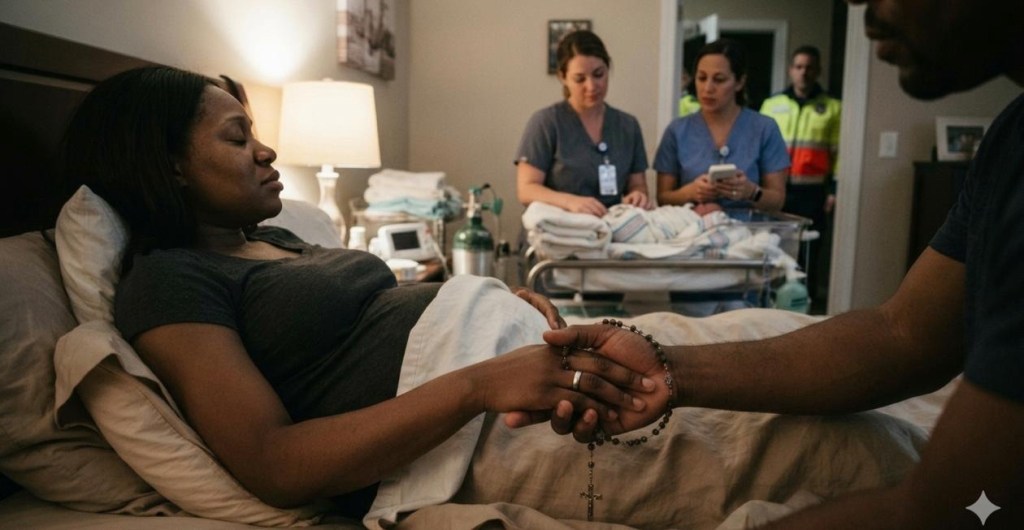
Within moments, two women entered our living room in quick succession. They moved with calm urgency, immediately attending to my wife and helping her get comfortable.
I stood there, bewildered.
Thankfully, our other children were spending the holidays with their grandparents. At least they would not be caught in the middle of the commotion.
I turned to my wife.
“Honey, please talk to me.”
She finally revealed the plan.
“I want to deliver at home this time.”
I stared at her.
“After everything we went through with the last delivery?”
She nodded.
My wife had already given birth four times in the hospital, but her last delivery had been traumatic. She had endured contractions for 28 hours, and the experience had left a lasting emotional wound.
I remembered how strongly I had felt afterward. I had even hoped she would take legal action against the hospital because of the risks and difficulties she believed she had experienced.
But she declined.
“What matters,” she had told me, “is that the baby and I are safe.”
This time, she wanted something different.
She had discussed the possibility of delivering vaginally after her previous cesarean section with the healthcare professionals involved in her care. What I did not know was that the clinicians she had consulted had advised against attempting it at home.
They recommended a hospital delivery, where emergency medical care would be immediately available if complications arose.
She understood their concerns, but she chose to proceed with a planned home birth. After acknowledging the risks and completing the necessary paperwork, she arranged for a doula and a midwife to attend the delivery.
Then she kept the entire plan from me.
Perhaps it was not because she did not love or trust me. Perhaps, after the trauma of her previous delivery, she simply wanted this birth to belong to her. She wanted to reclaim the experience on her own terms, at home, surrounded by familiar things and supported by people she trusted.
Perhaps, somewhere in her heart, she believed everything would be fine.
Trying to calm my fears and make sense of a situation I knew almost nothing about, I reached for two Rosaries. I placed one in my wife’s hand and held tightly to the other.
Then, amid the quiet urgency unfolding around us, I began to recite the Rosary under my breath, asking God to help us and keep my wife and unborn child safe.
The labor progressed.
Remarkably, the delivery was successful.
Our baby was born at home, and mother and child initially appeared to be doing well.
For a moment, everything seemed perfect. She had achieved the birth experience she wanted.
But childbirth does not always end when the baby arrives.
Shortly after the delivery, my wife developed a serious postpartum complication involving a significant vaginal tear.
The midwife recognized that something was wrong and immediately called the hospital. A doctor came on the line.
“This is an emergency. We are sending an ambulance now.”
Everything changed.
The peaceful home birth suddenly became an emergency transfer.
An ambulance arrived and took my wife to the hospital. She received intravenous treatment and was evaluated and cared for by the hospital team.
Thankfully, she stabilized and was discharged the following day.
And there I was, driving my wife and our newborn baby home.
Safe.
Together.
Grateful.
But the experience stayed with me.
I kept thinking about how quickly everything had changed.
What if the complication had been worse?
What if the midwife had not recognized it so quickly?
What if the hospital had been farther away?
What if the ambulance had taken longer?
And perhaps the question that troubled me most was this:
Should I have been told about the plan from the beginning?
Maybe she wanted the home birth to be a surprise. Maybe she knew how strongly I felt about the hospital after her previous traumatic delivery. Perhaps she thought she was protecting me from unnecessary anxiety.
But I could not help wondering what might have happened if I had been included.
Perhaps I would have asked more questions.
Perhaps I would have encouraged her to follow the clinicians’ recommendation and deliver in the hospital.
Perhaps, after understanding her reasons, I would have supported her decision anyway.
Perhaps together, we would have chosen differently.
I will never know.
She had the right to make decisions about her own body and birth experience. But this decision also affected how prepared our family would be if an emergency occurred. I did not want to control her or make the decision for her. I simply wanted the opportunity to understand, prepare and carry the weight of it beside her.
That experience taught me a painful but valuable lesson.
There are things that can be surprises.
And there are decisions that should never be surprises.
When a decision carries serious consequences for a mother and her unborn child, it deserves honest communication, careful consideration of medical advice and a full understanding of the risks.
What she intended as a beautiful surprise could, under different circumstances, have become a devastating phone call, with a family mourning instead of celebrating.
Thankfully, that was not our story.
My wife came home.
Our baby came home.
Instead of becoming a story of loss, it became a story of gratitude and a lesson we will always carry with us.
Sometimes, the people who love us most need to be brought into the conversation, not to make our decisions for us, but to help us carry them.
Because when the stakes are life and death, communication is not about control.
It is about trust.
By Joan A.Roberts
Bringing into the world another human it’s certainly not child’s play. It’s warfare!