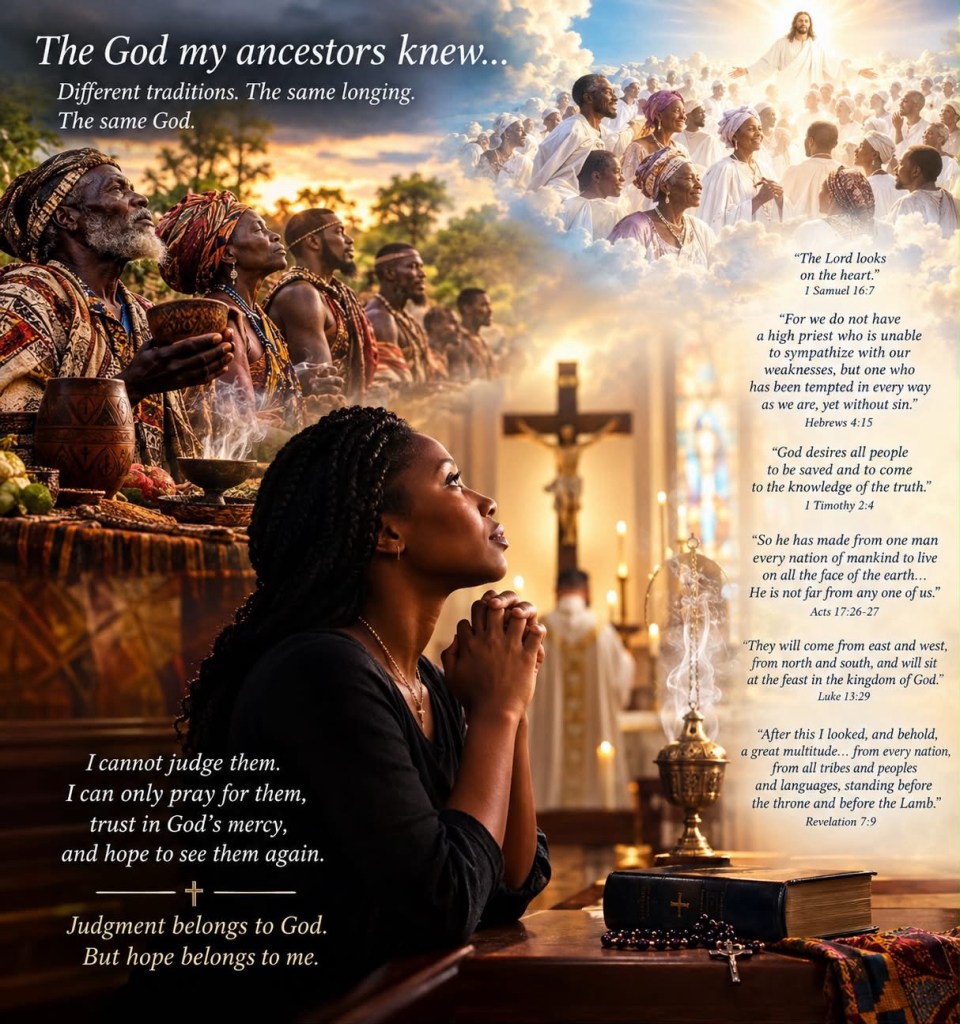
THE GOD MY ANCESTORS KNEW;
The God My Ancestors Knew
Sometimes, when I sit in church and watch the incense rise toward the ceiling, I think about my ancestors.
I wonder if heaven smells familiar to them.
The priest swings the thurible, and the smoke rises slowly toward the altar. The congregation becomes quiet. Some bow their heads. Some close their eyes. Some pray with their lips moving almost imperceptibly.
And I remember the old people.
The ones who poured libation.
The ones who stood beneath the African sky and called upon the names of those who came before them. The ones who offered incense, made sacrifices, sought forgiveness, asked for protection, and gathered as a community to acknowledge that there was something greater than themselves.
They did not call it Catholicism.
They did not know the Mass.
They did not have the Rosary.
They did not kneel before a crucifix.
But when I look at some of the things they practiced, I see something strangely familiar.
I see reverence.
I see incense.
I see offerings.
I see prayer.
I see thanksgiving.
I see people seeking forgiveness and reconciliation.
I see an understanding that our actions matter, that good and evil are not the same, and that there is a moral order beyond what human eyes can see.
I see people trying to reach toward God with the understanding they had.
And one question has stayed with me:
How will God judge them?
That question is not born out of a lack of faith.
It comes from my faith.
Because I believe in a God who is just, but I also believe in a God whose mercy is greater than my understanding.
My ancestors did not have what I have.
They did not have the Catechism.
They did not have the Gospel explained to them as I have heard it.
They did not have churches, priests, Bibles, or the sacraments as I know them today.
They had what they had been taught.
They had the traditions handed down through generations.
They had the wisdom of their elders.
They had their conscience.
They had the world around them.
They had the heavens above them and the earth beneath their feet.
And they sought answers.
They sought protection.
They sought forgiveness.
They sought peace.
They sought the Creator.
And I cannot stop wondering whether God heard them.
Scripture gives me reason to believe that God judges more deeply than human beings can.
The Bible says, “The Lord looks on the heart” (1 Samuel 16:7).
Not merely the ritual.
Not merely the outward appearance.
Not merely the name someone knew Him by.
The heart.
Paul says something even more striking in Romans 2. He speaks about people who did not possess the revealed law, yet whose conscience could still bear witness to what was right and wrong. He says that God will judge the secrets of the human heart (Romans 2:14–16).
That makes me pause.
Because perhaps God knows things about my ancestors that I will never know.
He knows what they were taught.
He knows what they were never taught.
He knows what they understood.
He knows what they misunderstood.
He knows what was done in ignorance.
He knows what was done knowingly.
He knows the difference between a heart deliberately rejecting God and a heart desperately searching for Him without knowing exactly where to find Him.
Paul once stood before people who worshipped without fully knowing the God they sought. And he told them about “the God who made the world and everything in it.” He told them that God was not far from them.
“He is not far from any one of us” (Acts 17:27).
I think about that often.
Perhaps God was not far from my ancestors either.
Perhaps when they looked toward the heavens, He saw what they could not yet understand.
Perhaps when they poured libation, He saw the longing underneath the ritual.
Perhaps when they burned incense, He saw hearts trying to reach toward the unseen.
Perhaps when they asked for forgiveness, God heard the cry beneath their words.
I am not saying that everything in African Traditional Religion was therefore identical to Catholicism.
It was not.
And I am not saying that every traditional practice was right.
Traditions, like people, can contain both wisdom and error.
But I have come to understand that Christianity did not create humanity’s longing for God.
That longing was already there.
Human beings everywhere have looked upward.
They have knelt.
They have prayed.
They have offered.
They have mourned their dead.
They have searched for forgiveness.
They have asked why we are here and what happens after we leave.
Perhaps the human heart has always been reaching toward the God who was already reaching toward us.
And then there is the question that perhaps troubles many of us:
What about our grandparents?
What about the people who came before Christianity reached them?
What about the grandfather who poured libation?
What about the great-grandmother who followed the traditions of her people?
What about the great-grandfather who tried to live an honorable life according to the knowledge he had?
Will we see them again?
I cannot promise anyone that.
And neither should I.
Heaven is God’s judgment, not mine.
But neither will I tell you that they are condemned simply because they did not know what I know.
The Apostle Paul tells us that God “desires all people to be saved” (1 Timothy 2:4).
That gives me hope.
And Jesus tells us that those who are entrusted with much are held accountable for much (Luke 12:47–48).
That tells me that God knows the measure of what each person received.
He knows what light came into someone’s life.
He knows what darkness surrounded them.
He knows what they did with the light they had.
So I will not try to take God’s seat.
I will not pronounce judgment on my ancestors.
Instead, I will pray for them.
I will remember them.
I will thank God for the good they gave to the generations that followed.
And I will place their souls into the hands of the God who knows them better than I ever could.
There is another Scripture that gives me comfort.
Paul tells believers not to grieve “as others do who have no hope” (1 Thessalonians 4:13).
Hope.
That word matters to me.
Because I want to believe that death does not have the final word.
I want to believe that the family bonds we experience here are not meaningless.
I want to believe that one day, if God grants me the grace of heaven, I may look across that great multitude and see people whose blood runs through me.
People whose names I know.
People whose names I have forgotten.
People whose stories were never written down.
My grandfathers.
My great-grandfathers.
The generations before them.
And perhaps I will recognize them.
Perhaps they will recognize me.
Scripture gives us a beautiful picture of heaven in Revelation 7:9—a multitude from “every nation, from all tribes and peoples and languages” standing before the throne of God.
Every nation.
Every tribe.
Every people.
Every language.
When I read that, I cannot help but think of Africa.
I cannot help but think of my ancestors.
I cannot help but hope.
Maybe one day, I will stand before God and finally understand everything that I cannot understand now.
Maybe I will understand what happened to the people who came before me.
Maybe I will understand their faith, their mistakes, their struggles, their traditions, and their search for God.
And perhaps, if they are there, I will not ask them why they did not know what I know.
I will simply embrace them.
And I will say:
“Grandfather, you were looking for Him too.”
Because perhaps that is the deepest truth I have learned.
I know the God of my ancestors through the light that I have received.
I know Him through Christ.
I know Him through the Church.
I know Him through Scripture and the sacraments.
But I cannot pretend that I know everything God was doing in the lives of the generations before me.
That belongs to God.
So if you worry about whether your grandparents, your great-grandparents, or your ancestors will be in heaven, do not let fear become the final word.
Pray for them.
Entrust them to God.
Ask God to have mercy on them.
And then live your own life faithfully.
Because the same God who will judge them will judge us.
And He will not judge according to our assumptions about one another.
He will judge with perfect knowledge.
Perfect justice.
And perfect mercy.
I cannot tell you that I will definitely see my ancestors in heaven.
But I can tell you this:
I hope I will.
I hope that the God I worship today is the same God they were reaching for yesterday.
I hope that the prayers they whispered beneath the African sky were heard by the same Father to whom I pray today.
I hope that when I finally see heaven, I will discover that God’s mercy was far greater than my fears.
And until that day comes, I will leave my ancestors where they belong:
in the hands of God.
I will not condemn them.
I will not forget them.
I will pray for them.
And I will hope.
Because judgment belongs to God.
But hope belongs to me.
And perhaps, one beautiful day, by the grace and mercy of God, I will walk through the gates of heaven and find that the people I thought I had lost were never truly lost to Him.
Perhaps I will see my grandfathers again.
Perhaps I will see my ancestors.
And perhaps, standing together before the throne of God, we will finally understand the mystery that none of us could fully understand on earth:
He was there all along