I know many of you have read some of my poems, especially I Have an Identity, and I remember some of the conversations and comments that followed.
Let me clarify something.
I am not writing against marriage.
I am not writing against men.
And I am not writing from a place of rejecting the beauty of family.
I believe in marriage. I love family. I love to love. I believe there is something beautiful about a man and a woman coming together to build a family when that relationship is embraced with maturity and responsibility spiritually, mentally, psychologically, emotionally, and socially.
Marriage can be wholesome.
Marriage can be healing.
Marriage can be a place where two people grow, serve, encourage, pray, build, and become better versions of themselves.
But marriage should not erase the people who enter it.
I should meet you better than I left you. And you should meet me better than you found me.
That is how I see marriage.
Your life should be better because you met that man.
His life should be better because he met that woman.
The children should be better because those two people came together.
The home should be better because love entered it.
Marriage should not diminish the individual. It should give two people an opportunity to strengthen one another.
Scripture says:
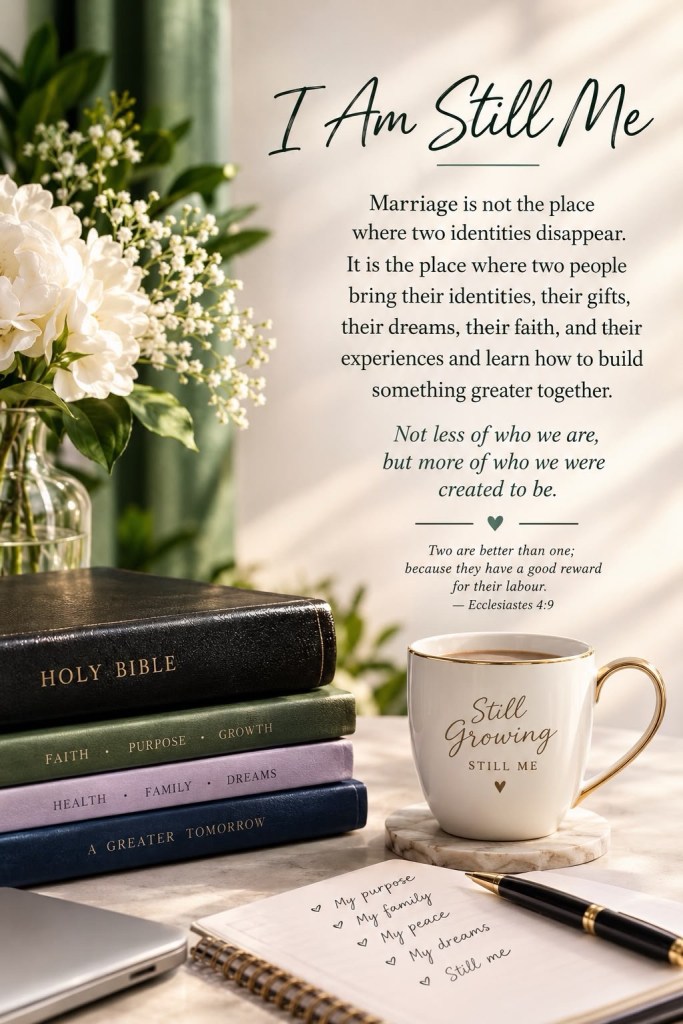
“Two are better than one; because they have a good reward for their labour.”
— Ecclesiastes 4:9
And there is another Scripture that has always fascinated me:
“How should one chase a thousand, and two put ten thousand to flight…”
— Deuteronomy 32:30
Look at the difference.
One.
Then two.
The power is not necessarily in one person becoming everything. Sometimes the power is in two people bringing what they have and working together.
That is why I believe a woman should not lose herself because she got married.
Many of us were raised to believe that everything begins and ends with marriage.
So when a husband dies, some women feel as though their entire world has died with him.
When a marriage ends in divorce, some feel as though their own lives have ended.
When a husband cheats, some women begin questioning their own worth.
When something goes wrong in the marriage, they begin asking:
What is wrong with me?
But sometimes, the question should be:
What happened to him? What happened to us? And what is God asking me to do with my own life now?
Because another person’s choices do not become your identity.
What your husband does defines his choices. It does not define you.
His betrayal is not your betrayal.
His weakness is not your weakness.
His failure is not your failure.
His death is not your death.
You did not cause another person to make his choices.
And if you had never met that person, would you say God had no purpose for your life?
Of course not.
You would still have been created.
You would still have had gifts.
You would still have had a purpose.
You would still have had a life to live.
So when circumstances change, why should you abandon yourself?
You are still you.
You still have a purpose.
You still have children who need you.
You still have gifts that need to be developed.
You still have prayers to pray.
You still have work to do.
You still have a God who knew you before you ever met the person you married.
And this is where 1 Corinthians 7 caught my attention.
Paul writes about marriage and says:
“The husband render unto the wife due benevolence: and likewise also the wife unto the husband.”
Then he says something remarkable:
“The wife hath not power of her own body, but the husband: and likewise also the husband hath not power of his own body, but the wife.”
Likewise also the husband.
I stopped there.
Because marriage is not presented as one person possessing the other while the other simply submits and disappears.
Paul speaks about mutual responsibility.
Mutual giving.
Mutual consideration.
Mutual belonging.
Even when husband and wife temporarily abstain from intimacy for fasting and prayer, Paul speaks of doing so by agreement and for a purpose.
There is mutuality.
There is consideration.
There is communication.
There is returning to one another.
There is the recognition that marriage is not simply physical. It is spiritual, emotional, relational, and deeply human.
And perhaps that is why prayer is so important in a home.
Not merely because we want God to answer our prayers, but because prayer creates a pattern.
A pattern of turning toward God together.
A pattern the children can see.
A pattern they can eventually carry themselves.
I remember a time when I was leaving the house and one of my sons stopped me.
“Mommy, we forgot to pray.”
I told him we could pray in the car.
So we prayed.
And something beautiful happened.
It became a habit for him.
Later, he would remind me.
“Mommy, can we pray again in the car?”
I had not given him a long lecture about developing a prayer life.
He simply watched.
He participated.
He remembered.
And eventually, he reminded me.
That is the power of what we establish in a home.
Sometimes the child reminds the parent.
Sometimes the spouse reminds the spouse.
And sometimes the Holy Spirit reminds all of us.
So yes, I believe in marriage.
I believe in family.
I believe in love.
But I also believe in identity.
A woman can love her husband without disappearing into him.
A man can love his wife without losing himself in her.
A mother can love her children without abandoning herself.
A person can experience grief without surrendering the rest of his or her life.
A person can experience betrayal without becoming the betrayal.
And a person can experience loss without losing purpose.
Marriage should not be the place where two identities disappear.
It should be the place where two people bring their identities, their gifts, their weaknesses, their dreams, their faith, and their experiences and learn how to build something greater together.
I should meet you better than I left you.
And you should meet me better than you found me.
If we are truly walking together, something in both of us should be growing.
Our wisdom should grow.
Our compassion should grow.
Our faith should grow.
Our ability to love should grow.
Our ability to serve should grow.
Our children should benefit from what we are building.
Our home should become better because we are in it.
That, to me, is the beauty of marriage.
Not that I cease to be me.
Not that you cease to be you.
But that we become better together.
And perhaps this is part of the mystery of two becoming one.
It is not one person disappearing into the other.
It is two people choosing to walk in the same direction.
Two people learning to give.
Two people learning to receive.
Two people learning to pray.
Two people learning to forgive.
Two people learning to grow.
Two people learning to build.
Because one may chase a thousand, but Scripture asks us to consider what two can do together.
So I will continue to say:
I have an identity.
I had one before marriage.
I have one within marriage.
And I will still have one when circumstances change.
Because my identity was never supposed to rest entirely in another human being.
I am a woman.
I am a mother.
I am a person with gifts, responsibilities, dreams, failures, lessons, and purpose.
And above all, I belong to God.
Marriage can be beautiful.
Love can be beautiful.
Family can be beautiful.
But the healthiest love does not ask you to disappear.
It calls you to become more fully who you were created to be.
And when two people do that together, perhaps they really can chase ten thousand.
Footnotes
- Genesis 2:18 — “It is not good that the man should be alone.” Marriage and companionship are presented as part of God’s design for human relationship.
- 1 Corinthians 7:3–4 — Paul describes marriage through mutual responsibility, mutual giving, and reciprocal consideration between husband and wife.
- Deuteronomy 32:30 — “How should one chase a thousand, and two put ten thousand to flight…” This illustrates the strength and multiplied effectiveness that can come through partnership.
Additional Scripture: Ecclesiastes 4:9–10 — “Two are better than one…” A reminder that companionship can strengthen people as they work and walk through life together.
By Joan A Roberts