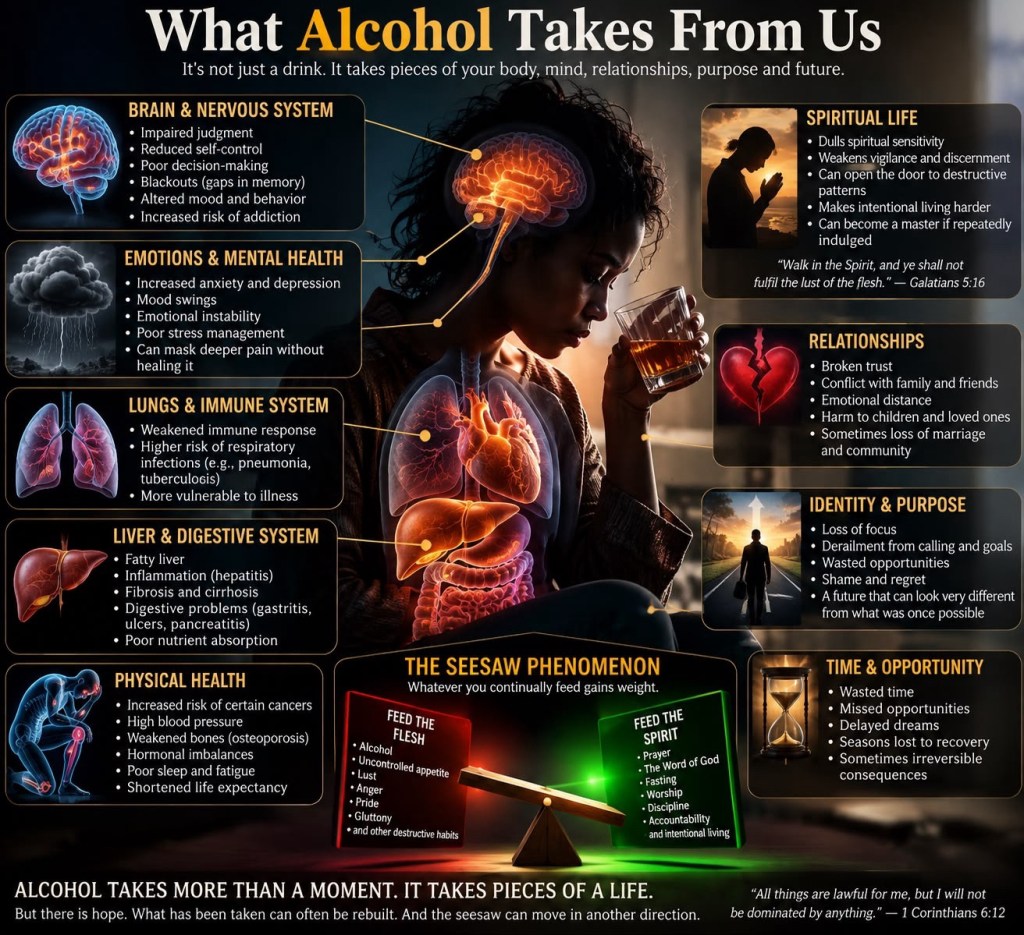
What Alcohol Takes From Us
Part One
It is easy to reduce the conversation about alcohol to one sentence:
“Alcohol is bad.”
Or, in Christian circles:
“Drinking is a sin.”
But sometimes a statement can be so brief that the person hearing it never gets the opportunity to understand the deeper question:
What does alcohol actually take from us?
And perhaps there is another question hiding underneath that one.
Why do people continue along certain paths even when they already know the possible devastation and consequences?
Why does knowing that something can damage the body, alter judgment, destroy relationships, disrupt families, interfere with purpose, or derail a future not always stop a person from doing it?
Why do human beings sometimes continue behaviors they themselves recognize as destructive?
Perhaps—just perhaps—the message was heard, but never understood deeply enough to challenge the reasoning behind the behavior.
Perhaps we sometimes tell people what not to do without helping them understand why.
Perhaps the message was never strong enough to provoke thought, challenge reasoning, educate the mind, awaken the conscience and speak to the soul.
Because information that merely frightens a person may eventually be forgotten.
Condemnation may produce shame without producing understanding.
But understanding can cause someone to stop long enough to ask:
What is this actually doing to me?
That is the conversation I want to have.
I am not asking these questions to judge the person holding a glass.
Neither am I interested in standing at a distance, pointing toward another person’s struggle and declaring myself more righteous.
I am asking because alcohol does something.
It does something chemically.
It does something neurologically.
It can affect behavior.
Judgment.
Coordination.
Memory.
It can affect the organs of the body.
And from my Christian perspective, anything capable of repeatedly interfering with judgment, consciousness and self-control deserves another question:
What might this also be doing to my spiritual vigilance?
BEYOND THE BOTTLE-
There are many dramatic claims surrounding alcohol.
Claims about the origin and ancient meaning of the word alcohol.
Claims connecting gin with jinn.
Claims about why alcoholic beverages are called spirits.
Claims connecting certain bottles, symbols, secret societies and occult practices.
Some of these claims are repeated so frequently that they begin to sound established.
But many are disputed, historically unsupported, or simply inaccurate.
And perhaps we don’t need them.
Because what we already know about alcohol is serious enough.
Alcohol acts on the central nervous system.
As intoxication increases, inhibition can decrease. Judgment may become impaired. Coordination and reaction time can deteriorate.
Memory can also be affected.
During an alcohol-related blackout, a person may remain awake.
The person may speak.
Walk.
Interact with other people.
Make decisions.
Yet during portions of that period, the brain may fail to properly form new memories.
Later, the person may genuinely have gaps in what they remember.
Think about that for a moment.
The body was present.
The person was interacting with the environment.
Yet portions of the experience were not being properly stored as memories.
That alone should provoke thought.
And alcohol does not stop with the brain.
Chronic heavy alcohol use can damage the liver.
Repeated injury may lead to inflammation and fibrosis. Over time, cirrhosis can develop, with extensive scarring and distortion of normal liver architecture.
The consequences of excessive alcohol use can reach other systems of the body as well.
So when I speak about alcohol spiritually, I am not replacing medicine with religion.
I am looking at the whole human being.
Body, Mind and Spirit
I believe the human being is more than a collection of organs.
We have a body.
We have a mind.
And I believe we possess a spiritual life.
Therefore, when something can alter consciousness, judgment, inhibition, memory and self-control, I cannot examine only what it does to the liver or brain.
I also have to ask:
What is it doing to the person?
As a Christian, sobriety means something to me.
Vigilance means something.
Discernment means something.
Self-control means something.
The ability to experience an appetite and still tell that appetite no means something.
The ability to recognize temptation without automatically obeying it means something.
This is why one particular passage of Scripture arrests my attention:
“All things are lawful for me, but I will not be dominated by anything.”
1 Corinthians 6:12
Dominated.
That is a powerful word.
Sometimes we spend so much time asking,
Can I do this?
that we forget to ask,
Is this beginning to master me?
And perhaps another question:
What am I becoming while I continue doing it?
There is an important distinction here.
Medicine can demonstrate alcohol’s effects on the nervous system, judgment, memory, behavior and organs.
Medicine has not demonstrated that alcohol literally removes the Holy Spirit from someone’s body or inserts a demonic spirit into a person.
Those are spiritual interpretations rather than established neurological findings.
But my Christian concern remains.
Scripture repeatedly calls us toward sobriety.
Vigilance.
Discernment.
Self-control.
And toward a life in which appetite does not become master.
Which brings me to something I learned very young.
THE SEESAW PHENOMENON-
I first understood what I now call the seesaw phenomenon In my early twenties “.
The simplest picture I have found for this is a seesaw.
And I have carried this picture for a very long time.
Like I earlier mentioned. I first caught this revelation or what I call the seesaw, phenomenon, in my early twenties.
I was very young.
But that simple revelation has, in no small measure, influenced my decision to live intentionally every day.
It taught me something I have never forgotten:
The mere declaration that I am a Christian is not enough. There must also be intentional Christian living.
Faith must be fed.
The spirit must be fed.
Because whatever side I continually feed becomes heavier.
If I continually feed appetite without restraint—whether through alcohol intoxication, sexual excess, uncontrolled anger, lust, gluttony, pride, or another uncontrolled desire—the flesh becomes heavier.
But if I continually feed my spirit through prayer, the Word of God, fasting, retreat, worship, discipline, obedience and simply remaining in His presence, my spirit becomes stronger.
The picture is simple:
Whatever I continually feed gains weight.
This is why the words of Paul in Galatians make such profound sense to me:
“Walk in the Spirit, and ye shall not fulfil the lust of the flesh.”
— Galatians 5:16
Walk.
Not visit.
Not occasionally remember.
Walk.
There is continuity in walking.
There is intention in walking.
There is movement.
One step followed by another.
In comparative terms, using my seesaw illustration, when the spirit man becomes the heavier side, the direction of one’s life increasingly follows the Spirit.
The flesh may still speak.
Temptation may still come.
Appetite may still knock.
But everything that knocks does not have to be given entrance.
And that kind of spiritual weight does not develop accidentally.
It comes with intention.
Consistency in prayer.
Consistency in the Word.
Consistency in fasting.
Consistency in retreat.
Consistency in worship.
Consistency in seeking His presence.
Consistency in choosing again tomorrow what you chose today.
Over time, living by the Spirit becomes more than something we profess.
It becomes the direction in which we have trained our lives to move.
And the opposite deserves equal attention.
Whatever we repeatedly feed in the flesh also gains weight.
One indulgence.
Then another.
One compromise.
Then another.
One secret.
Then another.
Until something we once believed we controlled begins attempting to control us.
Perhaps that is why simply saying “alcohol is bad” has never felt like enough of a conversation to me.
I want to know:
What does it affect?
What does it weaken?
What does it alter?
What am I feeding?
What am I strengthening?
What am I allowing to become heavier?
And ultimately:
What is becoming master?
Because the seesaw does not move according to what we merely profess.
It moves according to weight.
And weight is accumulated.
Choice by choice.
Habit by habit.
Day by day.
Whatever I continually feed gains weight.
And sometimes the easiest way to understand a principle is not through another lecture.
Sometimes you need a story.
And this is where mine begins.
Years ago, when I was much younger, I began thinking about a story.
At the time, I did not have all the language I have now.
I couldn’t explain everything medically.
I couldn’t explain everything spiritually.
But I understood something:
People rarely wake up one morning and decide,
“Today I will destroy everything I believe in.”
Sometimes it begins much more quietly.
One environment.
One invitation.
One compromise.
One secret.
Then another.
And somewhere along the way, one side of the seesaw becomes heavier.
So next let me tell you about Tamara.
To be continued…
The seesaw does not move according to what we merely profess. It moves according to weight.
What Alcohol Takes From Us
Part One
It is easy to reduce the conversation about alcohol to one sentence:
“Alcohol is bad.”
Or, in Christian circles:
“Drinking is a sin.”
But sometimes a statement can be so brief that the person hearing it never gets the opportunity to understand the deeper question:
What does alcohol actually take from us?
And perhaps there is another question hiding underneath that one.
Why do people continue along certain paths even when they already know the possible devastation and consequences?
Why does knowing that something can damage the body, alter judgment, destroy relationships, disrupt families, interfere with purpose, or derail a future not always stop a person from doing it?
Why do human beings sometimes continue behaviors they themselves recognize as destructive?
Perhaps—just perhaps—the message was heard, but never understood deeply enough to challenge the reasoning behind the behavior.
Perhaps we sometimes tell people what not to do without helping them understand why.
Perhaps the message was never strong enough to provoke thought, challenge reasoning, educate the mind, awaken the conscience and speak to the soul.
Because information that merely frightens a person may eventually be forgotten.
Condemnation may produce shame without producing understanding.
But understanding can cause someone to stop long enough to ask:
What is this actually doing to me?
That is the conversation I want to have.
I am not asking these questions to judge the person holding a glass.
Neither am I interested in standing at a distance, pointing toward another person’s struggle and declaring myself more righteous.
I am asking because alcohol does something.
It does something chemically.
It does something neurologically.
It can affect behavior.
Judgment.
Coordination.
Memory.
It can affect the organs of the body.
And from my Christian perspective, anything capable of repeatedly interfering with judgment, consciousness and self-control deserves another question:
What might this also be doing to my spiritual vigilance?
BEYOND THE BOTTLE-
There are many dramatic claims surrounding alcohol.
Claims about the origin and ancient meaning of the word alcohol.
Claims connecting gin with jinn.
Claims about why alcoholic beverages are called spirits.
Claims connecting certain bottles, symbols, secret societies and occult practices.
Some of these claims are repeated so frequently that they begin to sound established.
But many are disputed, historically unsupported, or simply inaccurate.
And perhaps we don’t need them.
Because what we already know about alcohol is serious enough.
Alcohol acts on the central nervous system.
As intoxication increases, inhibition can decrease. Judgment may become impaired. Coordination and reaction time can deteriorate.
Memory can also be affected.
During an alcohol-related blackout, a person may remain awake.
The person may speak.
Walk.
Interact with other people.
Make decisions.
Yet during portions of that period, the brain may fail to properly form new memories.
Later, the person may genuinely have gaps in what they remember.
Think about that for a moment.
The body was present.
The person was interacting with the environment.
Yet portions of the experience were not being properly stored as memories.
That alone should provoke thought.
And alcohol does not stop with the brain.
Chronic heavy alcohol use can damage the liver.
Repeated injury may lead to inflammation and fibrosis. Over time, cirrhosis can develop, with extensive scarring and distortion of normal liver architecture.
The consequences of excessive alcohol use can reach other systems of the body as well.
So when I speak about alcohol spiritually, I am not replacing medicine with religion.
I am looking at the whole human being.
Body, Mind and Spirit
I believe the human being is more than a collection of organs.
We have a body.
We have a mind.
And I believe we possess a spiritual life.
Therefore, when something can alter consciousness, judgment, inhibition, memory and self-control, I cannot examine only what it does to the liver or brain.
I also have to ask:
What is it doing to the person?
As a Christian, sobriety means something to me.
Vigilance means something.
Discernment means something.
Self-control means something.
The ability to experience an appetite and still tell that appetite no means something.
The ability to recognize temptation without automatically obeying it means something.
This is why one particular passage of Scripture arrests my attention:
“All things are lawful for me, but I will not be dominated by anything.”
1 Corinthians 6:12
Dominated.
That is a powerful word.
Sometimes we spend so much time asking,
Can I do this?
that we forget to ask,
Is this beginning to master me?
And perhaps another question:
What am I becoming while I continue doing it?
There is an important distinction here.
Medicine can demonstrate alcohol’s effects on the nervous system, judgment, memory, behavior and organs.
Medicine has not demonstrated that alcohol literally removes the Holy Spirit from someone’s body or inserts a demonic spirit into a person.
Those are spiritual interpretations rather than established neurological findings.
But my Christian concern remains.
Scripture repeatedly calls us toward sobriety.
Vigilance.
Discernment.
Self-control.
And toward a life in which appetite does not become master.
Which brings me to something I learned very young.
THE SEESAW PHENOMENON-
I first understood what I now call the seesaw phenomenon In my early twenties “.
The simplest picture I have found for this is a seesaw.
And I have carried this picture for a very long time.
Like I earlier mentioned. I first caught this revelation or what I call the seesaw, phenomenon, in my early twenties.
I was very young.
But that simple revelation has, in no small measure, influenced my decision to live intentionally every day.
It taught me something I have never forgotten:
The mere declaration that I am a Christian is not enough. There must also be intentional Christian living.
Faith must be fed.
The spirit must be fed.
Because whatever side I continually feed becomes heavier.
If I continually feed appetite without restraint—whether through alcohol intoxication, sexual excess, uncontrolled anger, lust, gluttony, pride, or another uncontrolled desire—the flesh becomes heavier.
But if I continually feed my spirit through prayer, the Word of God, fasting, retreat, worship, discipline, obedience and simply remaining in His presence, my spirit becomes stronger.
The picture is simple:
Whatever I continually feed gains weight.
This is why the words of Paul in Galatians make such profound sense to me:
“Walk in the Spirit, and ye shall not fulfil the lust of the flesh.”
— Galatians 5:16
Walk.
Not visit.
Not occasionally remember.
Walk.
There is continuity in walking.
There is intention in walking.
There is movement.
One step followed by another.
In comparative terms, using my seesaw illustration, when the spirit man becomes the heavier side, the direction of one’s life increasingly follows the Spirit.
The flesh may still speak.
Temptation may still come.
Appetite may still knock.
But everything that knocks does not have to be given entrance.
And that kind of spiritual weight does not develop accidentally.
It comes with intention.
Consistency in prayer.
Consistency in the Word.
Consistency in fasting.
Consistency in retreat.
Consistency in worship.
Consistency in seeking His presence.
Consistency in choosing again tomorrow what you chose today.
Over time, living by the Spirit becomes more than something we profess.
It becomes the direction in which we have trained our lives to move.
And the opposite deserves equal attention.
Whatever we repeatedly feed in the flesh also gains weight.
One indulgence.
Then another.
One compromise.
Then another.
One secret.
Then another.
Until something we once believed we controlled begins attempting to control us.
Perhaps that is why simply saying “alcohol is bad” has never felt like enough of a conversation to me.
I want to know:
What does it affect?
What does it weaken?
What does it alter?
What am I feeding?
What am I strengthening?
What am I allowing to become heavier?
And ultimately:
What is becoming master?
Because the seesaw does not move according to what we merely profess.
It moves according to weight.
And weight is accumulated.
Choice by choice.
Habit by habit.
Day by day.
Whatever I continually feed gains weight.
And sometimes the easiest way to understand a principle is not through another lecture.
Sometimes you need a story.
And this is where mine begins.
Years ago, when I was much younger, I began thinking about a story.
At the time, I did not have all the language I have now.
I couldn’t explain everything medically.
I couldn’t explain everything spiritually.
But I understood something:
People rarely wake up one morning and decide,
“Today I will destroy everything I believe in.”
Sometimes it begins much more quietly.
One environment.
One invitation.
One compromise.
One secret.
Then another.
And somewhere along the way, one side of the seesaw becomes heavier.
So next let me tell you about Tamara.
To be continued…
The seesaw does not move according to what we merely profess. It moves according to weight.