Marriage Is a Covenant, Not Captivity
By Joan A. Roberts
Very often, we are quick to judge, condemn, crucify, and ostracize.
We look at a person at the point of their failure and suddenly forget every other version of them that ever existed.
But when did we begin reducing a human being to a single failure, as though we ourselves were without fault?
Marriage is a call to covenant, not captivity.
Perhaps one of the greatest mistakes we make in marriage is believing that understanding someone means excusing everything they do.
It does not.
You can understand where a person came from and still acknowledge that they are hurting you.
You can understand his childhood.
You can understand what he witnessed growing up.
You can understand the home that formed him.
You can understand the things nobody taught him.
You can understand the wounds he carried into adulthood.
Sometimes what we call a “generational curse” is a pattern that has traveled unquestioned from one generation to another.
A boy watches something long enough and begins to believe that is what a man does.
A girl survives something long enough and begins to believe that is what a woman is supposed to endure.
Then two adults meet, carrying entire households inside them, and call it marriage.
Understanding this should give us compassion. But compassion should never become an excuse.
Do not excuse a man’s actions simply because you understand how he became the man he is.
At some point, adulthood requires responsibility.
At some point, healing requires participation.
At some point, a person must decide that what happened before him will not continue through him.
And love cannot make that decision for another human being.
What does love really mean?
Love is responsibility. It says, “I see where you are, and I will not abandon you because of it.”
But love can also say:
“I may step back to protect myself, but I will not disappear into hatred.”
There are people you may have to love from a safe distance.
There are people you can pray for without continuing to place yourself where they can destroy you—or destroy the dream, the purpose, and the person God is still developing within you.
There are people you can forgive without returning to the environment that wounded you.
That is not necessarily hatred.
Sometimes it is wisdom.
“For better, for worse” was never supposed to mean that one person may create the worse while the other spends a lifetime proving commitment by surviving it.
So I sometimes wonder:
Was it commitment, or was it convenience?
Was it covenant, or was it performance?
When you told me you loved me, what did you really mean?
For a lifetime?
Temporarily?
Or only for as long as things felt perfect?
Longevity alone does not tell us the quality of a marriage.
Two people can remain married for decades and still spend those decades emotionally separated.
People can share an address and no longer share a life.
People can sleep beside one another and be strangers.
Sometimes we praise the number of years without asking what those years contained.
There must also be room for humanity.
Your husband will not always look the way he did when you met him. Your wife will not always look the way she did when you first fell in love.
Bodies change.
Faces change.
Money changes.
Health changes.
Circumstances change.
People age.
And if the foundation of marriage is only physical allure, what happens when life does what life inevitably does?
Marriage cannot survive on attraction alone.
Neither can it survive on fear.
This is where I believe some of us, especially people of faith, have to be careful.
Marriage is sacred. But marriage is not God.
Your husband is not God.
Your wife is not God.
Sometimes, without realizing it, we become so frightened of losing a marriage that we begin compromising the very relationship with God that was supposed to teach us how to live within that marriage.
We stop listening to conviction.
We silence ourselves.
We overlook what we know is wrong.
We call fear “submission.”
We call disappearance “sacrifice.”
We call endless tolerance “faith.”
Slowly, almost imperceptibly, keeping the marriage becomes more important than keeping ourselves aligned with God.
You were afraid of losing him, so somewhere along the way, you began losing yourself.
And perhaps that is the tragedy.
You traded God to keep your marriage. And the person you traded God for traded you all the same—to keep his pride, his pleasure, or whatever mattered more to him in that moment.
Now what?
You cannot keep a human being by abandoning God.
You cannot force someone to choose you.
You cannot pray another person’s free will out of existence.
And you should never have to destroy yourself to prove that you understand covenant.
You cannot change your body to keep him.
You cannot remove something from your body to keep him.
You cannot add something to your body to keep him either.
Because if changing yourself is what it takes to keep somebody, what exactly are you keeping?
If he stays rooted in God, you do not need to chase him or exhaust yourself trying to hold on to him.
And if you cannot keep him, perhaps he was never yours to begin with.
A person rooted in God does not need to be held in place by your fear.
So maybe the answer was never to hold another human being tighter.
Maybe the answer was to hold God tighter.
“Seek ye first the kingdom of God, and his righteousness; and all these things shall be added unto you.”
Amen.
Perhaps, if we put things back in their proper order, we will finally understand that marriage can be precious without becoming an idol; forgiveness can be genuine without eliminating boundaries; and love can remain love even when wisdom says:
Not like this.
Because if keeping a marriage requires losing God, losing yourself, ignoring truth, and calling destruction devotion, then perhaps what you are preserving is no longer the covenant you believed you were protecting.
By Joan A.Roberts
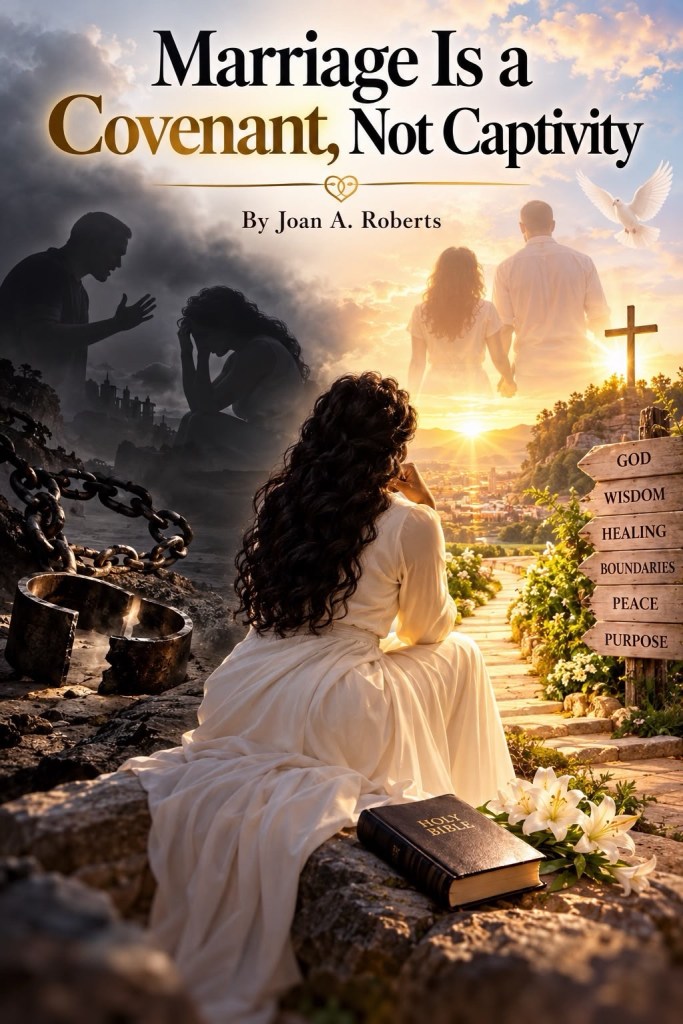
Marriage Is a Covenant, Not Captivity
By Joan A. Roberts
Very often, we are quick to judge, condemn, crucify, and ostracize.
We look at a person at the point of their failure and suddenly forget every other version of them that ever existed.
But when did we begin reducing a human being to a single failure, as though we ourselves were without fault?
Marriage is a call to covenant, not captivity.
Perhaps one of the greatest mistakes we make in marriage is believing that understanding someone means excusing everything they do.
It does not.
You can understand where a person came from and still acknowledge that they are hurting you.
You can understand his childhood.
You can understand what he witnessed growing up.
You can understand the home that formed him.
You can understand the things nobody taught him.
You can understand the wounds he carried into adulthood.
Sometimes what we call a “generational curse” is a pattern that has traveled unquestioned from one generation to another.
A boy watches something long enough and begins to believe that is what a man does.
A girl survives something long enough and begins to believe that is what a woman is supposed to endure.
Then two adults meet, carrying entire households inside them, and call it marriage.
Understanding this should give us compassion. But compassion should never become an excuse.
Do not excuse a man’s actions simply because you understand how he became the man he is.
At some point, adulthood requires responsibility.
At some point, healing requires participation.
At some point, a person must decide that what happened before him will not continue through him.
And love cannot make that decision for another human being.
What does love really mean?
Love is responsibility. It says, “I see where you are, and I will not abandon you because of it.”
But love can also say:
“I may step back to protect myself, but I will not disappear into hatred.”
There are people you may have to love from a safe distance.
There are people you can pray for without continuing to place yourself where they can destroy you—or destroy the dream, the purpose, and the person God is still developing within you.
There are people you can forgive without returning to the environment that wounded you.
That is not necessarily hatred.
Sometimes it is wisdom.
“For better, for worse” was never supposed to mean that one person may create the worse while the other spends a lifetime proving commitment by surviving it.
So I sometimes wonder:
Was it commitment, or was it convenience?
Was it covenant, or was it performance?
When you told me you loved me, what did you really mean?
For a lifetime?
Temporarily?
Or only for as long as things felt perfect?
Longevity alone does not tell us the quality of a marriage.
Two people can remain married for decades and still spend those decades emotionally separated.
People can share an address and no longer share a life.
People can sleep beside one another and be strangers.
Sometimes we praise the number of years without asking what those years contained.
There must also be room for humanity.
Your husband will not always look the way he did when you met him. Your wife will not always look the way she did when you first fell in love.
Bodies change.
Faces change.
Money changes.
Health changes.
Circumstances change.
People age.
And if the foundation of marriage is only physical allure, what happens when life does what life inevitably does?
Marriage cannot survive on attraction alone.
Neither can it survive on fear.
This is where I believe some of us, especially people of faith, have to be careful.
Marriage is sacred. But marriage is not God.
Your husband is not God.
Your wife is not God.
Sometimes, without realizing it, we become so frightened of losing a marriage that we begin compromising the very relationship with God that was supposed to teach us how to live within that marriage.
We stop listening to conviction.
We silence ourselves.
We overlook what we know is wrong.
We call fear “submission.”
We call disappearance “sacrifice.”
We call endless tolerance “faith.”
Slowly, almost imperceptibly, keeping the marriage becomes more important than keeping ourselves aligned with God.
You were afraid of losing him, so somewhere along the way, you began losing yourself.
And perhaps that is the tragedy.
You traded God to keep your marriage. And the person you traded God for traded you all the same—to keep his pride, his pleasure, or whatever mattered more to him in that moment.
Now what?
You cannot keep a human being by abandoning God.
You cannot force someone to choose you.
You cannot pray another person’s free will out of existence.
And you should never have to destroy yourself to prove that you understand covenant.
You cannot change your body to keep him.
You cannot remove something from your body to keep him.
You cannot add something to your body to keep him either.
Because if changing yourself is what it takes to keep somebody, what exactly are you keeping?
If he stays rooted in God, you do not need to chase him or exhaust yourself trying to hold on to him.
And if you cannot keep him, perhaps he was never yours to begin with.
A person rooted in God does not need to be held in place by your fear.
So maybe the answer was never to hold another human being tighter.
Maybe the answer was to hold God tighter.
“Seek ye first the kingdom of God, and his righteousness; and all these things shall be added unto you.”
Amen.
Perhaps, if we put things back in their proper order, we will finally understand that marriage can be precious without becoming an idol; forgiveness can be genuine without eliminating boundaries; and love can remain love even when wisdom says:
Not like this.
Because if keeping a marriage requires losing God, losing yourself, ignoring truth, and calling destruction devotion, then perhaps what you are preserving is no longer the covenant you believed you were protecting.

