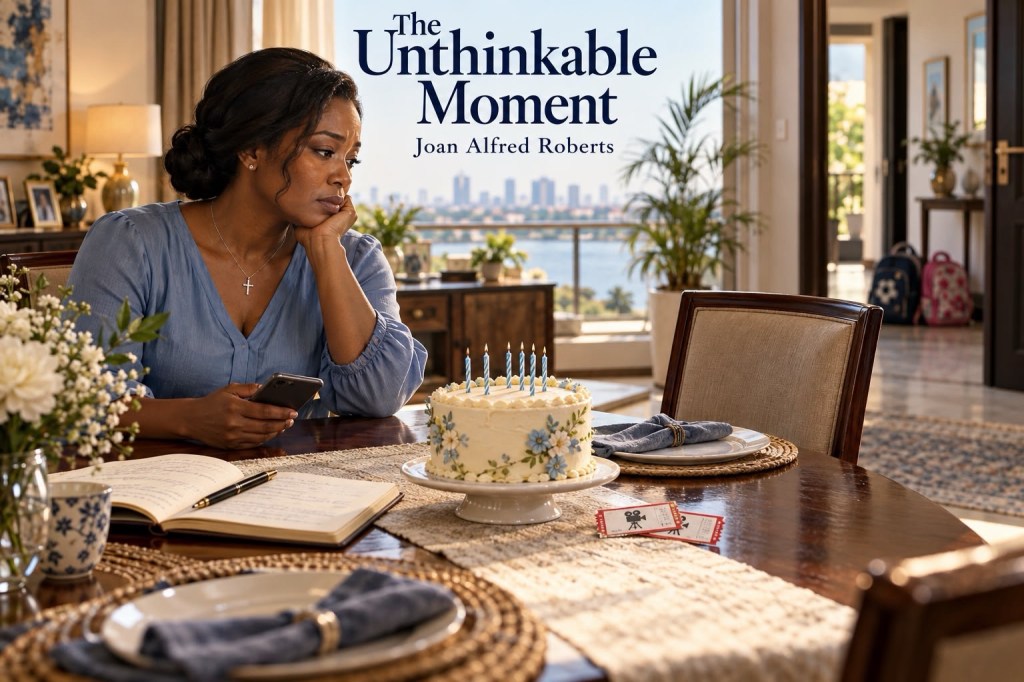
Now the story…
The Unthinkable Moment
A short story by Joan Alfred Roberts
That morning, we both woke up full of life.
We had enjoyed each other the night before. There was laughter, tenderness, and the familiar conversations of two people who still liked being together.
As usual, my husband was preparing to leave for work.
“Honey, could you rest a little?”
“Rest? We just woke up.”
“You own the business. Why must you rush there every day?”
“Because I own it. If I expect people to arrive early, shouldn’t I arrive early too? Perhaps first?”
“You’re a billionaire. Employ somebody to hold the keys. Build staff housing nearby. Let somebody else open the company sometimes.”
“My wife, I know you’re a lecturer. But not this morning, please.”
“At least this lecture is free.”
He glanced at my feet.
“I paid for those slippers.”
“And you’ve enjoyed an excellent return on your investment.”
He laughed.
“At least eat breakfast here.”
“I’ll take it with me.”
“Then I’ll bring lunch and find breakfast still unopened, looking as offended as I am.”
“I’ll eat both. An hour apart.”
“You’ve scheduled two meals you haven’t eaten?”
“Scheduling is important.”
“And your hypertension medication?”
“I take it once a day.”
“Please be consistent, honey. And take it easy on yourself.”
“I promise.”
We knelt to pray.
He lowered himself slowly, one hand against the bed. When we finished, he struggled to stand.
I noticed.
I almost asked, but could already hear him teasing, “Are you my wife or a detective?”
Then the children called, and the morning continued.
We kissed goodbye. I handed him his lunchbox and turned to our twins, Emmanuella and Emmanuel.
They were eight—smart, prayerful, playful children who believed their mother had six hands. One wanted her hair fixed; the other couldn’t find a pencil sitting inside his school bag.
I loved being their mummy.
After taking them to school, I bought a cake and cinema tickets. It was their father’s birthday. We would have dinner at home, then go out for a film.
He loved cake. For someone who forgot breakfast, he seldom needed reminding when cake was available.
Still, I kept thinking about how he had struggled during prayers.
Should I drive to his office? It wasn’t far.
Should I call?
“Honey, can we go for a checkup together?”
I wasn’t afraid of him. I just didn’t want another complaint about being lectured. He kept business appointments faithfully; checkups required persuasion.
Perhaps I should wait until he came home. I needed time to prepare his birthday dinner before collecting the children at two.
I kept deciding how to say it.
Then I called.
“Hi, baby. Are you at work?”
“Yes. I’m preparing for a meeting.”
He sounded excited about closing a deal.
“Have you forgotten it’s your birthday?”
“Is it my birthday?”
I laughed.
“That’s why I have you, sweetheart. What are you planning?”
“Surprise, surprise. Wait until you come home.”
He mentioned the meeting again. I was still talking about dinner.
The question I had rehearsed remained unasked.
He laughed before we ended the call.
That was the last time I heard his voice.
At noon, my phone rang.
“Are you Mrs. Ademola?”
“Yes.”
The voice hesitated.
“Go on. Yes, I am.”
“Your attention is needed at the hospital.”
The caller gave me an address in Ikoyi.
“Who is there?”
There was a long pause.
“Hello?”
I called my husband.
No answer.
I called again.
Nothing.
It had to be him.
The roads were strangely clear. Most people were already at work. I drove toward the hospital, thinking of the question I should have asked.
When I arrived, a doctor told me my husband had been pronounced dead only a minute earlier.
They had tried to resuscitate him. All efforts had failed.
He spoke of cardiomyopathy and ventricular fibrillation.
“But I just spoke to him,” I said. “He was laughing.”
Then I learned that my husband had called the doctor the previous day because he had lost his antihypertensive medication. An appointment had been arranged.
He had never made it.
He hadn’t told me.
His assistant later explained that, shortly after our call, he had slumped in his chair. He never left for the meeting.
Someone also told me why the deal had mattered so much.
He was planning a new car for me and our next holiday.
My car was perfectly fine.
He had been preparing his surprise while I was preparing mine.
He was in his late forties; I was in my early forties. Our children didn’t need more luxury. They needed us around.
I had told him repeatedly.
“The best includes you coming home and sitting down.”
“I sit down.”
“At your desk. That doesn’t count.”
Afterward, I replayed every conversation. I wished I had insisted on the checkup. I could not know whether it would have changed the outcome, but regret kept asking.
Mourning has not been easy.
For three months, almost every other night, I have dreamed of you.
One night, you sat beside me in white clothes, held me, and unfolded a letter.
“My love,
“I wish I had told you about the medication. I wish I had let you help.
“I wish we had written the book.”
You had promised a book about having a beautiful wife.
“That should fill several volumes,” I had said.
I offered to write while you told your stories—Cape Town, Zimbabwe, the people you met, the life you had lived.
We never began.
“There would have been pieces of me in those pages,” you read. “Something for you and our children.
“Tell my son I love him. Tell my daughter I love her.
“And you, my wife, my best friend, my confidant—I love you. I’m sorry death took me away.
“If you choose to love again, that choice belongs to you. Think of me loving you with the angels.
“Keep my company alive, if you can. Care for my workers. Don’t let them be forgotten.”
“You should have taught me,” I whispered.
“I thought we had time.”
“So did I.”
Since your death, people had asked about accounts, projects, agreements, and records. Too often, I didn’t know.
“Take care of yourself,” you continued. “Rest sometimes.”
“You’re telling me to rest?”
“I left room in the letter for your objections.”
Even then, you made me laugh through my tears.
“I love you always.
“Your one and only husband.”
I woke shivering and sweating.
You were not there. Neither was the letter.
A dream, a memory, or something I could not explain—I still don’t know.
But beneath it all, I keep returning to that hospital.
I screamed. I ran outside. People followed and held me.
Someone helped me sit down.
Then I looked at my phone.
The children.
I had to collect them at 2 p.m.
They had gone to school that morning with a father.
How was I supposed to bring them home and tell them he was gone?
A Reflection
Treasure the little moments—the laughter, shared meals, prayers, and ordinary goodbyes. Only God knows the full span of a person’s life.
Be observant. Ask the question. Speak with tenderness, but speak. Do not postpone a caring conversation simply because someone may find your concern uncomfortable.
Let trusted loved ones know how they can help while you are still here to guide them. Explain your plans, where important records are, and whom to contact. You do not have to share every password to give them direction.
We cannot prevent every loss. Hindsight does not make us responsible for everything we wish we had done differently.
But we can listen, share what matters, and say the loving words.
Do not assume there will always be another evening.
Scripture Notes
- Ecclesiastes 9:11: “Time and chance happeneth to them all.”
- James 4:14: “For what is your life? It is even a vapour, that appeareth for a little time, and then vanisheth away.”
- Psalm 139:16: A reflection on God’s knowledge of our days before they unfold.