They tell us,
keep going.
Keep reaching.
Keep climbing.
Keep acquiring.
Keep pressing forward
as though every step backward
is a step lost.
But sometimes
the wisest thing you can do
is stop.
Stand still.
And look over your shoulder.
Because what if
the thing slowing you down
is not the mountain ahead,
but the string behind?
What if you have been pulling
and pulling,
thinking you were climbing,
when something unseen
has been pulling you downward?
Sometimes you must retreat
to regain your strength.
Retrace your steps
to find what you missed.
Retract your pride
and return to the place
where you once thought
you had nothing more to learn.
There are seasons
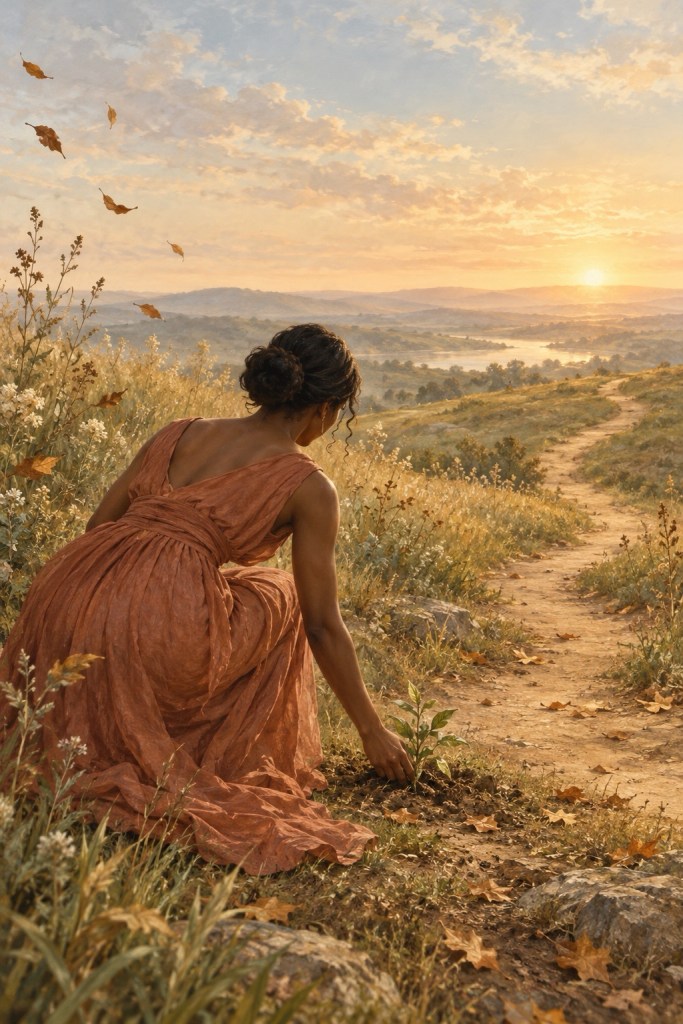
when you must stoop
before you can conquer.
Not because you are weak.
Because you are wise enough
to bend.
Wise enough to listen.
Wise enough to sit among those
you once thought were behind you
and discover that they carry
something you need.
There is no shame
in reaching downward
when your purpose
is still reaching upward.
Sometimes the lower place
becomes the classroom.
Sometimes the pause
becomes the preparation.
Sometimes the retreat
becomes the road.
And sometimes
what looks like going backward
is simply God giving you time
to untangle the string
that has been holding you down.
So I will not be ashamed
of the places where I stooped.
I will not despise
the seasons when I had to begin again.
For I have learned:
You do not always conquer
by climbing higher.
Sometimes,
You stoop to conquer.
By Joan A.Roberts
Authors note:
By Joan A.Roberts
Writing this poem made me think about how deeply
childhood shapes the way we move through adult life.
The lessons we receive, the things we witness, and
the patterns we learn can stay with us long after
childhood ends. I thought of W. H. Davies’s poem
‘Leisure’1, which I read growing up and have carried
with me ever since. Its invitation to pause and notice
life echoes the reflection behind this poem.
Here, stooping is not surrender. It is a purposeful
pause or retreat: a chance to regain strength,
reconsider our direction, and return with renewed
purpose. In the rush of work, screens, and daily
demands, we can be physically present yet mentally
elsewhere. We need to make room for God, for our
children and parents, and for those closest to us.
When we put God at the center, we can see our
ambitions and distractions in perspective. We
remember that our relationships matter, and we can
choose to be present for one another.
Reference: W. H. Davies, ‘Leisure,’ in Songs of Joy and Others (1911).

