The Gift in the Pain
Have you ever wondered why Jesus came into the world in a manger?
The King of kings could have arrived in a palace. He could have been surrounded by gold, comfort, and influential people. Instead, He arrived in a place that looked ordinary, uncomfortable, and unworthy of a king.
Perhaps that was one of life’s earliest lessons: beautiful things do not always arrive in beautiful packaging.
Some of the prettiest things come dressed in ugly jackets.
When life is comfortable, we can easily overlook what matters. But difficult seasons make us search more carefully. We pray more sincerely. We read Scripture with different eyes. We notice the money forgotten between the pages of a Bible. We remember the friend we neglected to call. We discover opportunities we were too comfortable—or too distracted—to see before.
Pain can make us pay attention.
I once prayed earnestly for a particular outcome. I believed I knew exactly how the answer should look. I had imagined its appearance, its timing, and perhaps even the name it would carry.
But when the answer came, it did not look like an answer.
It came with a devastating look, an obnoxious aura, and a disgraceful appearance. It carried a name that did not resemble mine. Nothing about it looked like the blessing for which I had prayed.
So I cried.
I cried until I was tired, and then I slept.
When I woke up, the situation had not disappeared. But something inside me had changed. I began to look beyond its appearance.
Slowly, I saw opportunities.
I saw doors I had not noticed before. I saw lessons, possibilities, and a path toward another level of my life. What had first appeared to be disgrace began to look like redirection.
The pain had not been meaningless.
Sometimes we condemn an outcome too quickly because it does not look like our prayer. We call it punishment because it arrived without beauty. We reject it because it embarrassed us, frightened us, or forced us to change direction.
But there is often more than meets the eye.
A closed door may be protecting us.
A loss may be moving us.
An uncomfortable ending may be introducing a beginning that comfort would never have allowed us to pursue.
This does not mean that pain is pleasant. It does not mean we should pretend that disappointment does not hurt. Cry if you need to cry. Rest when your strength is gone. Give yourself time to understand what has happened.
But do not condemn the entire season while you are still standing inside its darkest moment.
The Bible tells us to give thanks in all circumstances—not because every circumstance feels good, but because God may still be working through what we cannot yet understand.
Some gifts announce themselves with celebration.
Others arrive wrapped in confusion, embarrassment, or loss.
Do not despair too soon.
The gift may be hidden inside the pain.
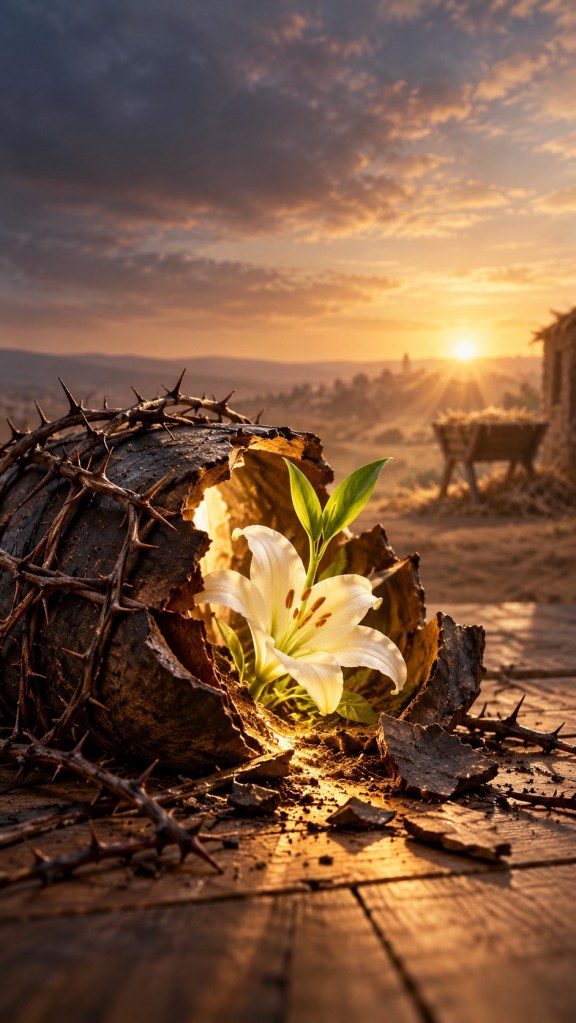
The thorns and broken exterior represent suffering; the illuminated lily and new growth represent the blessing concealed within it.

