WHEN A SURPRISE BECAME A LESSON.

“I think my water just broke.”

“Honey, I think the baby is on the way.”

I looked at my wife, trying to understand what I had just heard.

“Are you sure? Then why are you acting so calm? You are not flustered. You are not rushing around. You are not even telling me to take you to the hospital!”

She smiled.

It was that quiet, mysterious, slightly mischievous smile I remembered from college. It was the same smile she used to give me when we met at our little hideout, where we escaped from the world and spent time together.

But there was something different about that smile now.

“I have plans,” she said.

“What plans?”

“I was hoping to keep them from you.”

“What plans?” I stuttered, my confusion quickly turning into fear.

I was worried about my unborn son. I was also unsettled by how calm and completely unbothered my wife appeared to be.

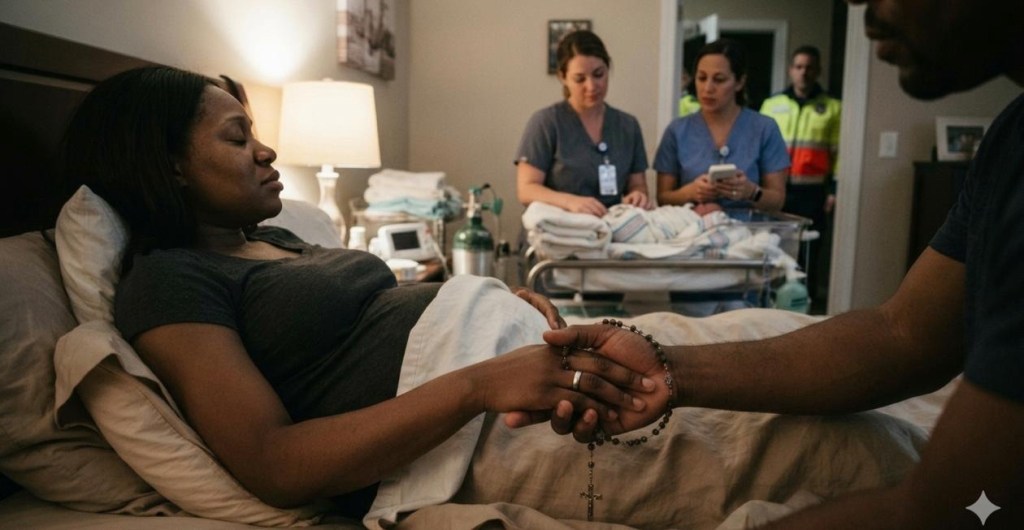
“I already called my doula and my midwife. They are both on their way.”

“A doula? What is a doula?”

Before she could answer, the doorbell rang.

Then it rang again.

Within moments, two women entered our living room in quick succession. They moved with calm urgency, immediately attending to my wife and helping her get comfortable.

I stood there, bewildered.

Thankfully, our other children were spending the holidays with their grandparents. At least they would not be caught in the middle of the commotion.

I turned to my wife.

“Honey, please talk to me.”

She finally revealed the plan.

“I want to deliver at home this time.”

I stared at her.

“After everything we went through with the last delivery?”

She nodded.

My wife had already given birth four times in the hospital, but her last delivery had been traumatic. She had endured contractions for 28 hours, and the experience had left a lasting emotional wound.

I remembered how strongly I had felt afterward. I had even hoped she would take legal action against the hospital because of the risks and difficulties she believed she had experienced.

But she declined.

“What matters,” she had told me, “is that the baby and I are safe.”

This time, she wanted something different.

She had discussed the possibility of delivering vaginally after her previous cesarean section with the healthcare professionals involved in her care. What I did not know was that the clinicians she had consulted had advised against attempting it at home.

They recommended a hospital delivery, where emergency medical care would be immediately available if complications arose.

She understood their concerns, but she chose to proceed with a planned home birth. After acknowledging the risks and completing the necessary paperwork, she arranged for a doula and a midwife to attend the delivery.

Then she kept the entire plan from me.

Perhaps it was not because she did not love or trust me. Perhaps, after the trauma of her previous delivery, she simply wanted this birth to belong to her. She wanted to reclaim the experience on her own terms, at home, surrounded by familiar things and supported by people she trusted.

Perhaps, somewhere in her heart, she believed everything would be fine.

Trying to calm my fears and make sense of a situation I knew almost nothing about, I reached for two Rosaries. I placed one in my wife’s hand and held tightly to the other.

Then, amid the quiet urgency unfolding around us, I began to recite the Rosary under my breath, asking God to help us and keep my wife and unborn child safe.

The labor progressed.

Remarkably, the delivery was successful.

Our baby was born at home, and mother and child initially appeared to be doing well.

For a moment, everything seemed perfect. She had achieved the birth experience she wanted.

But childbirth does not always end when the baby arrives.

Shortly after the delivery, my wife developed a serious postpartum complication involving a significant vaginal tear.

The midwife recognized that something was wrong and immediately called the hospital. A doctor came on the line.

“This is an emergency. We are sending an ambulance now.”

Everything changed.

The peaceful home birth suddenly became an emergency transfer.

An ambulance arrived and took my wife to the hospital. She received intravenous treatment and was evaluated and cared for by the hospital team.

Thankfully, she stabilized and was discharged the following day.

And there I was, driving my wife and our newborn baby home.

Safe.

Together.

Grateful.

But the experience stayed with me.

I kept thinking about how quickly everything had changed.

What if the complication had been worse?

What if the midwife had not recognized it so quickly?

What if the hospital had been farther away?

What if the ambulance had taken longer?

And perhaps the question that troubled me most was this:

Should I have been told about the plan from the beginning?

Maybe she wanted the home birth to be a surprise. Maybe she knew how strongly I felt about the hospital after her previous traumatic delivery. Perhaps she thought she was protecting me from unnecessary anxiety.

But I could not help wondering what might have happened if I had been included.

Perhaps I would have asked more questions.

Perhaps I would have encouraged her to follow the clinicians’ recommendation and deliver in the hospital.

Perhaps, after understanding her reasons, I would have supported her decision anyway.

Perhaps together, we would have chosen differently.

I will never know.

She had the right to make decisions about her own body and birth experience. But this decision also affected how prepared our family would be if an emergency occurred. I did not want to control her or make the decision for her. I simply wanted the opportunity to understand, prepare and carry the weight of it beside her.

That experience taught me a painful but valuable lesson.

There are things that can be surprises.

And there are decisions that should never be surprises.

When a decision carries serious consequences for a mother and her unborn child, it deserves honest communication, careful consideration of medical advice and a full understanding of the risks.

What she intended as a beautiful surprise could, under different circumstances, have become a devastating phone call, with a family mourning instead of celebrating.

Thankfully, that was not our story.

My wife came home.

Our baby came home.

Instead of becoming a story of loss, it became a story of gratitude and a lesson we will always carry with us.

Sometimes, the people who love us most need to be brought into the conversation, not to make our decisions for us, but to help us carry them.

Because when the stakes are life and death, communication is not about control.
It is about trust.

By Joan A.Roberts

Bringing into the world another human it’s certainly not child’s play. It’s warfare!
My Silly Little Dog

His name was Billy, and he had been with me for only about a year.

My children called him Buddy, but I called him my friend and bodyguard.

Billy went almost everywhere with me. Every evening, he would sit on the couch beside me while I watched television. Eventually, he would fall asleep, and when I was ready to go to my room, I would pick him up and lay him down in his place.

That became our routine.

He was also very protective. Whenever strangers came around, or whenever he noticed something suspicious, Billy would bark.

But Billy had his silly ways.

He never pooped inside the house, but sometimes, when he was hungry or upset, he would stretch his right leg strangely away from his body and pee on the floor.

It took me a while to understand that this was his way of communicating with me.

One day, Billy did something wrong and, for the first time, I spanked him lightly on his backside.

Billy looked at me.

Then he made a little crying noise. I even thought I saw tiny tears in his eyes.

I felt terrible.

But with Billy, you could never be completely sure. Was he really upset? Or was this another performance because he wanted more food or attention?

That was Billy.

Later that same day, he disappeared.

I came home from work, and he was gone.

The next morning, I stepped outside to get into my car and could not believe what I saw.

An elderly woman who lived only a few houses away was taking Billy for a walk.

My Billy.

And Billy seemed perfectly comfortable.

I considered reporting her. After all, he was my dog. But when I looked at the woman, I hesitated. She was elderly, and perhaps she needed companionship.

But then again, I needed companionship too. My children had gone away to college, and Billy had become my little companion.

Eventually, I reported him missing.

I hoped I would hear that the woman had simply found Billy and taken him home.

But apparently, that was not exactly what happened.

The story I heard was that the woman had been having a family gathering. There was a fire burning outside. Perhaps the smoke caught Billy’s attention.

Or maybe it was the smell of steak.

Somehow, Billy jumped over the fence and landed in her yard.

And what did my supposedly lost dog do?

He walked into the middle of the family gathering, went straight to the elderly woman, and sat beside her, wagging his tail as though he had already decided where he belonged.

Then somebody gave him a plate with steak.

And that, apparently, was how Billy got himself adopted.

Written by; Joan A.Roberts

THE SEASON I FOUND MY VOICE.

The Season I Found My Voice

I wondered why the words came rushing,
why the dreams began to rise,
why my hands reached toward creation
while my heart still searched for my children’s eyes.

I carried love through empty spaces,
I carried grief beneath my smile;
yet somewhere within the sorrow,
a hidden garden came alive.

I am still a mother.
That truth will never fade.
But I am also Joan,
the woman God has made.

The quiet did not erase me,
the storm did not steal my name;
instead, it revealed the voice within me
that was waiting to awaken.

I miss what my heart still longs for,
I grieve what I cannot hold.
Yet I will keep becoming,
with a faith that makes me bold.

For every season bears a purpose,
every tear can nourish growth;
and the woman rising from the ashes
is still the mother they know.

IT WAS ALWAYS THERE.

It Was Always There

We mock the strength within us
each time we crown “I cannot” as truth.

Yet when death knocks,
when a diagnosis counts our days,
when failure calls us by name,
the same tired hands begin to build,
the same doubtful mind begins to focus,
and the same knees remember how to pray.

Where did the strength come from?

It was not born in the crisis.
It was always there:
a seed placed by the Greatest Architect,
waiting for our deliberate yes.

The wound may have been inherited,
and the pattern may have been modeled,
but the betrayal was still chosen.

And choice cuts both ways.

Faithfulness can be chosen.
Purity can be practiced.
Integrity can be guarded.
Holiness can be pursued.
Hard work can become a habit.
Academic excellence can be built.
A blank page can become art.

Every worthy goal can be pursued
when we deliberately give it
our minds, our hearts, and our hands.

Speak it with your tongue.
Choose it with your heart.
Pursue it with your mind.
Carry it with your soul.

Not because we are more than human,
but because we are human:
created by the Greatest,
awakened by purpose,
strengthened by grace,
and finally willing
to reach for what was always there.

Written by Joan A. Roberts

THE DIFFICULT LANGUAGE OF LOVE..by Joan A. Roberts

Love does not always speak softly.

Sometimes it speaks through patience.
Sometimes through distance.
Sometimes through a boundary drawn quietly,
not because love has disappeared,
but because love must also learn respect.

You can forgive
without pretending you were never hurt.

You can pray for a marriage
without returning too quickly
to the place where your heart was wounded.

You can hope for reconciliation
without forcing tomorrow
to arrive today.

Sometimes love says,
I still care.

And wisdom answers,
Then care from a safe distance for now.

Sometimes faith says,
Wait.

Not wait while being mistreated.
Not wait while losing yourself.
Not wait while fear becomes normal.

But wait with dignity.
Wait with boundaries.
Wait while watching actions,
not merely listening to promises.

Because reconciliation is more than coming back together.

It is honesty meeting accountability.
Forgiveness meeting change.
Love meeting respect.
And two people deciding that the old wounds
will not become the blueprint for a new beginning.

You can remain kind
without surrendering your peace.

You can leave the door open
without standing in the doorway all day.

You can love someone
and still say,
This must change.

Perhaps that is one of love’s most difficult languages:

To remain hopeful without becoming blind.
To forgive without forgetting wisdom.
To be patient without becoming passive.
To believe in restoration
without sacrificing yourself to obtain it.

Where there has been abuse,
love should never demand a hurried return.

Real change needs time to speak for itself.

And perhaps, if love is truly returning,
you will not have to chase it.

You will recognise it
in consistency,
in gentleness,
in accountability,
in respect.

Faith can keep the heart open.

Wisdom can guard the door.

And when both walk together,
love may still find its way home.
Written by Joan A. Roberts

Author’s Note

This poem was born from the understanding that not every provocation requires a response, not every truth must be shouted, and not every battle is won through words. First Peter 3:1 reminds me that godly conduct can sometimes speak more powerfully than repeated arguments, while Psalm 39:1 teaches the wisdom of guarding the tongue in difficult moments.

This kind of silence is not weakness, surrender, or the acceptance of mistreatment. It is the discipline of knowing when to speak, how to speak, and when to allow character to speak on one’s behalf. It is choosing not to let anger turn pain into destructive words.

The prayer of Psalm 141:3 captures the heart of this poem: “Set a guard, O Lord, over my mouth; keep watch over the door of my lips.” James 1:19 further reminds us to be quick to listen, slow to speak, and slow to anger. Sometimes the greatest evidence of strength is not in having the final word, but in possessing the self-control to leave some words with God.

By Joan A. Roberts

Who Sent Me Message? — Part Two (BCT–AIT Journey)

By Joan Roberts

I stepped through the doorway and immediately felt it—rows upon rows of bunk beds stretching across the room like a sleep factory I had somehow been assigned to.

No privacy. No softness. No gentle introduction.

Just bunks, bags, women moving quickly, and the unmistakable feeling that everyone else already seemed to know what they were doing.

For a moment, I simply stood there with my suitcase in hand, taking it all in.

I knew I had come for military training, of course. But knowing something in theory and standing right in the middle of it are two very different things.

This was not a place you eased into.

It was a place you adapted to, survived, learned to laugh in, and somehow kept moving through.

And somewhere between the bunk beds, the noise, and my rapidly disappearing sense of personal space, one question entered my mind:

Who sent me message?

When it was my turn to enter after the search, I was asked whether I thought I was going on vacation.

Perhaps my beige-and-cream luggage and lavender backpack—all rather posh-looking—made it appear as though I were boarding a cruise ship instead of reporting for military training.

As though that were not enough, a female drill sergeant giggled and said,

“Welcome to BCT!”

Welcome indeed.

During orientation, I quickly understood that we were expected to function almost like robots: listen, obey, move quickly, and ask as few questions as possible.

Our phones were taken from us, placed in bags, locked away, and returned only on certain Saturdays or Sundays.

Phone time was always quite a sight.

Many of us—including me—could be seen crying while speaking to our parents or spouses. Sometimes we cried because we missed them. At other times, we were passionately reporting the week’s ordeals: the shouting, the drills, the training, the exhaustion, and, of course, the endless running.

I was never quite sure who was chasing us or why we had to run so much.

My company was determined to be the best, so we trained as though they were trying to produce the next Usain Bolt from among us.

Running was simply part of the culture.

Young, old, tired, enthusiastic—it did not seem to matter very much.

We ran.

There were physical fitness requirements to meet, company standards to maintain, and a reputation to protect. Our company often performed well, and once you become known for doing well, it appears excellence develops an appetite of its own.

The unspoken message seemed to be:

Run or get out.

Naturally, I asked what all the running was for.

I was told it was part of preparing us physically for the demands of military life—to move quickly when necessary, to respond under pressure, and to build endurance.

I cannot remember whether I repeated the explanation perfectly, but trust me—I asked questions all the time.

That habit appeared to irritate quite a few people.

However, I was not raised in America, and I regarded the entire experience as a rare privilege. If I was going to survive it, I wanted to understand it.

Apparently, curiosity and military obedience do not always march in the same formation.

My age also attracted attention.

I was older than many of the trainees around me, and people sometimes complimented my strength, flexibility, dexterity, or ability to keep up.

At first, I simply accepted the compliments.

Then I discovered something dangerous about compliments: they can quietly create expectations.

Someone would say, “Wow, you can still do that?”

And something inside me would immediately answer:

Still?

That one word could add another mile.

I had not deliberately entered into competition with anyone, but somehow I seemed to have brought a little competition upon myself.

The more people noticed what I could do, the more determined I became not to disappoint them—or myself.

So while some of the younger trainees may have looked at me with admiration, I was sometimes thinking:

Please stop complimenting me. You are making me work harder.

Still, there was something satisfying about discovering that age did not automatically mean inability.

I could still move.

I could still learn.

I could still keep pace.

And occasionally, I could still surprise people—including myself.

My body, however, sometimes had opinions of its own.

My determination would say, We are soldiers.

My knees would quietly reply, We need to talk.

There was rarely time for the meeting.

I also remember watching the women help one another braid their hair into cornrows. They took turns, and I quietly prayed that my own hair would remain presentable so I would not need to ask anyone for help.

My hair, however, had other plans.

Its texture made it vulnerable to becoming rough very quickly, so eventually I joined the queue and sought help too.

Unfortunately, hairstyling was not one of my talents, so I could not return the favor.

I could offer gratitude, conversation, encouragement, and perhaps moral support—but no one with good judgment should have handed me a comb.

Some mornings, we woke as early as 2:00 a.m. to train in the woods, assemble for formation, or work out.

Those early mornings greeted me with considerable disgust.

It was not that I enjoyed lying lazily in bed, but this old lady certainly needed time to recover from the previous day’s drills.

The BCT curriculum, however, did not appear to include a course titled Rest and Recovery for Mature Recruits.

Its philosophy was much simpler:

Keep going until graduation.

One part I genuinely enjoyed was the food—and the portion sizes.

At first, I walked into the dining facility smiling, but I soon learned to control both my appetite and my emotions. I could not let everyone discover too quickly that I was a committed foodie.

My greatest complaint was that the drill sergeants seemed determined that we should finish eating in about ten minutes.

Everything appeared to last ten minutes.

Eating.

Bathing.

Dressing.

Possibly breathing.

There was never enough time.

I once thought I could take my leftovers with me.

After all, it was my food, was it not?

No.

We were searched at the door, and taking leftovers outside was considered contraband.

Imagine becoming a suspected criminal over a piece of chicken.

Once the meal was over, we simply had to wait for the next one.

There would be no secret midnight reunion between me and my leftovers.

About once a month, however, we had special weekends when visitors could meet us at the PX—the Post Exchange.

For a few precious hours, we could see familiar faces, shop, eat, and briefly remember what ordinary life felt like.

The PX seemed almost like freedom.

We could buy food and other items, and for a moment I felt as though I could finally relax and enjoy myself.

But there was always a catch.

Whatever we purchased still had to comply with the rules, and many things could not be taken back into the barracks.

Just when you thought you were about to groove, a drill sergeant or timekeeper would appear to remind you that you were still a trainee.

Your time was not entirely your own.

Your movements were controlled.

And for that season, you practically belonged to the United States government.

Did some people break the rules?

Of course.

Some trainees were caught with alcohol, stolen items, or other prohibited things and were promptly sent home.

The Army did not appear particularly interested in lengthy negotiations.

Our sleeping quarters remained crowded.

Privacy was not merely limited; it had gone absent without leave.

As training progressed, things changed somewhat.

There were fewer of the constant corrective drills and fewer occasions when push-ups seemed to be the universal answer to every problem.

We were expected to behave more like the “big boys and girls” of training by then.

We marched to class, often singing cadence along the way, and much of our day became focused on learning our MOS.

Classes usually ran Monday through Friday, often from about 8:00 a.m. until 5:00 p.m.

For someone who genuinely enjoys learning, this part suited me.

Books.

Lessons.

Actual explanations.

Finally, something that looked familiar.

But this was still military training.

At lunchtime, we were called out of class and made to line up properly.

One drill sergeant stood in front and another behind us, as though watching carefully for an outlier attempting to escape into civilian life.

Even the walk to lunch was not boring.

We marched.

We sang.

We swung our arms.

And we wore the appropriate expressions of enthusiasm.

Whether you were tired, hungry, confused, or privately reconsidering every decision that had brought you there, you smiled and kept moving.

At times I wondered whether my face had enlisted too.

That was military training.

Little privacy.

Very little time.

Plenty of running.

Marching.

Classes.

Compulsory enthusiasm.

Occasional moments of freedom at the PX.

And enough unforgettable experiences to last a lifetime.

Looking back now, I realize that I did not simply learn discipline there.

I was reshaped by it.

The version of me that first walked into that sleep-factory barracks was uncertain, questioning, and slightly overwhelmed.

The version that emerged had learned to move through discomfort without breaking, to ask questions even when they were unwelcome, to laugh at absurdity, and to keep going even when everything in me wanted to stop.

I did not become someone else.

I became more of who I had always been—only under pressure, under orders, and under circumstances I never would have chosen for myself.

I may have arrived looking as though I were prepared for a cruise, but I left knowing something far more important:

I could endure what I never thought I could survive—and still come out standing.

So, who sent me message?

Courage did.

And apparently, courage also expected me to run.

Author’s Note

This story reflects my personal experience and perspective during military training. It is not intended to represent the experiences of every Soldier or to serve as an official representation of the United States Army.

WHO SENT ME MESSAGE? Part One.

My Unforgettable Welcome to Basic Combat Training

Nothing could have fully prepared me for my arrival at Basic Combat Training.

If not for the YouTube videos I watched at home before joining the military—as suggested by my recruiter—the experience might have been much worse, perhaps even a nightmare. Those videos gave me an idea of what to expect. I anticipated the shouting, running, drills, and confusion, so I arrived feeling somewhat prepared.

Still, watching Basic Combat Training from the comfort of one’s home is very different from living it.

There was no gentle welcome, friendly tour, or quiet moment to settle in. Instead, we were welcomed with what felt like a war simulation.

Smoke from training grenades filled the air and clouded our view. Recruits began scrambling in different directions, searching for safety. Somewhere through the smoke and confusion, a female drill sergeant shouted instructions, directing us to use our instincts and find our way to safety.

I remember thinking, Is this really how they welcome people to BCT?

For a moment, I wondered what might happen if someone had an unknown heart condition or asthma. Recruits are expected to be medically fit, but some people may be unaware of an underlying condition. Others may be so desperate for employment, financial stability, or affordable education that they put not only their best foot forward—but occasionally a false one too.

Despite the confusion, I found the simulation strangely exciting. I ran through the smoke, barely able to see where I was going, until I eventually reached safety. We formed a long line and were led toward the cafeteria.

For one brief moment, I thought the worst was over.

I was wrong.

Afterward, we were ordered to retrieve our bags without assistance. We had to carry everything ourselves—bags in both hands and sometimes balanced on our heads—while drill sergeants shouted at us to move faster.

“Run!”

“Get your bags!”

“Open them for inspection!”

Commands came from every direction. There was hardly enough time to understand one instruction before another followed.

I was in my very late thirties, almost forty, when I entered Basic Combat Training. My ambitious mind insisted that I could handle everything, and my face still carried a youthful appearance. My body, however, spoke disdainfully—and much louder—than either my ambition or my youthful looks.

My mind said, Keep going.

My body replied, Madam, are you sure about this?

But as we sometimes say in Nigerian Pidgin:

Wetin man go do? I go die here.

What else could I do? I had come too far to turn back.

“I go die here” did not mean that I expected to die. It was a declaration of determination. It meant that I had made my decision: I was there to stay, endure the training, and make the opportunity work.

Returning to the trenches of lack was not an option.

Not everyone is fortunate enough to be recruited into the military or to pass the required examinations. I knew that I had been given an opportunity, and I did not intend to waste it.

For me, joining the military also came during a pause in my medical journey, when I was reconsidering how and when to challenge the board examinations. At that time, the boards and I were not quite ready for each other. The military offered me a different challenge, a source of stability, and an opportunity to discover another side of myself.

Still, somewhere within the chaos of that first day, I felt one or two tears escape.

Then the questions began forming in my mind—in Nigerian Pidgin, of course:

Who send me message?
Abi na prison I come?
Abi na secondary school?
Wetin be this sef?

In other words:

Who asked me to come here?
Did I come to prison?
Is this secondary school?
What exactly is all this?

I was so lost in my private thoughts that I temporarily forgot where I was. A sharp command abruptly returned me to the present.

“Get down, Soldier! Give me ten push-ups now! Why are you standing there instead of following instructions and opening your bags?”

Just like that, my private conversation with myself ended.

I dropped to the ground.

One. Two. Three.

There was no time for tears, explanations, or second thoughts. Basic Combat Training had begun, and I was already learning its first lesson: whether frightened, confused, exhausted, or older than many of the recruits around me, I still had to listen, move, and keep going.

Looking back, the experience was frightening, fascinating, and almost humorous. Beneath the smoke, shouting, heavy bags, aching muscles, and push-ups, something new was beginning to emerge.

The woman who arrived wondering, Who sent me here? was about to discover that she possessed more courage, endurance, and adaptability than she realized.

My body might have spoken louder than my ambitious mind that day—but my determination had the final word.

That unforgettable welcome was only the beginning.

The views and experiences expressed in this personal essay are my own and do not represent the official position of the United States Army or the Department of Defense.

By: Joan.A.Roberts