As an African, I sometimes struggle to explain what it means to “take a walk in the woods” simply to admire nature.
Where I come from, disappearing into the bushes alone is not always interpreted as a peaceful attempt to clear one’s mind. If I had spoken too freely about wandering into the woods for quietness, someone might have wondered whether I had lost my mind, fallen into some strange spiritual practice, or needed to be taken behind an ambulance for a mental-health evaluation.
Perhaps the Western world simply developed different ways of resting, unwinding, and making room for oneself. In my culture, however, family is often the refuge after a difficult day. There are few grand rituals of solitude. Life is busy, laughter is shared, sleep is precious, and rest can sometimes feel like a luxury.
Yet, strangely enough, even as a child growing up in Africa, I found myself running to the bushes.
My family would search everywhere for me. When they finally found me and asked where I had been, I would simply say, “I went to the woods.”
They thought I had probably inherited the idea from the novels I read or the Western films I watched. Perhaps they were right. Books had opened doors in my imagination that geography could not close. The Chronicles of Narnia, The Sound of Music, games like Scrabble and Chinese checkers, and stories of distant places introduced me to worlds beyond my immediate surroundings.
My family sometimes wondered whether I secretly wished I were not African, whether I dreamed of living overseas, or whether I longed to belong somewhere beyond our shores.
But they were only partly right.
I did not want to escape Africa. I simply discovered, very early, that the human imagination has no borders.
In those quiet places, I would watch birds move through the branches and listen to them hum their little songs. I watched leaves fall, change colour, and cling to the branches before finally surrendering to the wind. I did not necessarily admire trees and leaves for their own sake. What fascinated me was what they seemed to say about people.
I love flowers more than forests—the flowers in a vase at home, the flowers growing stubbornly along pavements, and those appearing unexpectedly beside roads and shores. I look at lilies, daffodils, roses, sunflowers, and even the strange beauty of plants and creatures like porcupines, and somehow I see people in them.
Some are delicate. Some are thorny. Some bloom loudly. Others survive quietly in places where no one expects them to grow.
Perhaps that is what I have been doing all my life: finding people in nature and nature in people.
There is a famous line by William Henry Davies: “What is this life if, full of care, / We have no time to stand and stare?” Perhaps he was reminding us that a life consumed entirely by urgency can leave us too busy to notice that we are alive.
I understand that now.
I may have been geographically misplaced, but perhaps I was never spiritually misplaced. I was simply a child with a boundless heart, reading beyond my borders, imagining beyond my surroundings, and finding quiet wherever the world allowed me to breathe.
The books, games, films, and travels shaped me. They gave me windows into diverse worlds without taking away the world from which I came.
And I have no regrets.
I still retreat into quietness. I still watch birds. I still notice flowers growing where nobody planted them. I still gather ideas from falling leaves and changing seasons.
And somewhere between Africa and all the worlds I discovered through stories, I found my own place—not necessarily in a country, but in the vast human imagination, beneath the mighty hand that holds this universe together. By Joan A.Roberts
I had just returned from Atlanta, and I was tired.
Not just physically tired. I was tired in that peculiar way that comes from traveling, being with your children, trying to make sure everything is done, and then realizing that you haven’t had a single moment to simply unwind.
There had been no time for my own manicure or pedicure. No time to sit down and breathe. Work was waiting. I needed to look presentable, composed, ready.
So I went to the salon to make my hair.
And I knew what came with the territory.
Gossip.
There is always someone in the salon who has a story to tell, and someone else who is ready to listen. Normally, I keep myself out of it. I don’t gossip, and I don’t add to gossip.
But that day, I was tired.
So I decided to simply sit.
Listen.
Watch.
Laugh when something was funny.
And rest.
I wasn’t participating in the gossip. I was simply allowing myself to enjoy the company of another human being without feeling the need to correct, educate, or withdraw.
The woman doing my hair has always thought I was a little irritable. Sometimes she thinks I believe I am better than her.
I have told her before, “I am no better than you. God simply made us different.”
And that day, I explained what I meant.
I may be book-smart, but that doesn’t mean I am street-smart. I could spend years in school collecting degrees, but when I need my hair done, guess where my money goes?
To her.
I cannot stand in front of a mirror and create what she creates.
She can.
And perhaps she can do much more than that.
That made her smile.
Then I remembered something I had read many years ago—the idea that there are things the B and C students know that the A students sometimes don’t.
Because sometimes, the person who didn’t spend all their time chasing grades learns how to build something, sell something, create something, negotiate something, or turn a skill into a living.
And eventually, the A student may become the customer.
She became excited.
And then she began to tell me her story.
The businesses she had built.
The things she had done.
The different ventures she had tried.
How long she had been around.
How she had used her businesses—including hair making and other ventures—to educate her children, even sending them to places like Harvard and Oxford.
One child traveled. Another pursued a master’s degree.
And I sat there watching her.
Not correcting her.
Not competing with her.
Not comparing my achievements with hers.
I watched her exercise something beautiful:
pride in what she had built.
And for the first time, I saw something childlike in her.
There was innocence in the way she told her story.
She wanted to be heard.
She wanted someone to know that her life mattered.
That her work mattered.
That what she had contributed to her children mattered.
And I realized something.
People don’t always want you to tell them they are extraordinary.
Sometimes they simply want to know that you see them.
My mother taught me this lesson early.
She was a nurse, but being a nurse was not the only thing she knew how to do.
She made hair.
She made our clothes and did alterations.
She could make things with her hands.
She didn’t need to pay somebody else to do everything for us because she had learned how to do many things herself.
I wasn’t particularly interested in sewing.
But I found my own things.
I baked cakes.
I cooked.
And wherever I traveled, I could learn how to make the food of that place. Sometimes I would even create something in my head, only to discover later that somebody else had already given it a name.
And then there was drawing.
I had almost forgotten that I could draw.
Back in the day, I would draw for myself and my friends. My fine-art teacher would look at a drawing and say, “You all get zero. I know Joan did this for you.”
Writing was the same.
We would be given essays to write. Someone would ask me to help them.
The teacher would read it and say, “I know Joan wrote this.”
They knew my signature.
And that is when it struck me:
We all have a signature.
There may be thousands of hairdressers.
Thousands of writers.
Thousands of cooks.
Thousands of doctors.
Thousands of artists.
Thousands of people doing exactly what you do.
But nobody does it exactly the way you do it.
There are similarities.
There are common grounds.
There are people who have the same training, the same tools, the same opportunities.
But somewhere inside what you produce is a tiny thing that belongs only to you.
Your signature.
It may be so small that you don’t even recognize its value.
But somebody else may see it immediately.
That is what makes one person’s work different from another person’s work, even when they are doing the same thing.
It is why one hairdresser has customers who will travel across town just to sit in her chair.
It is why one writer’s words stay with you long after you close the book.
It is why one cook can take the same ingredients as everybody else and somehow make you say, “How did you do that?”
It is the signature.
And sometimes, we become so obsessed with degrees, titles, credentials and achievements that we forget the value of craft.
A degree is wonderful.
Education matters.
But education is not the end of human usefulness.
My mother taught me that a person should know how to do something with their hands.
Learn a craft.
Develop a skill.
Make yourself useful.
Because you never know when the thing you thought was small will become the thing someone else desperately needs.
And so, as I sat in that salon that day, I realized that I had gone there exhausted, expecting to be bombarded with gossip.
Instead, I witnessed something else.
I witnessed a woman remembering her own worth.
I gave her room to tell her story.
And in doing so, I discovered something about myself too.
Sometimes wisdom is knowing when to speak.
Sometimes it is knowing when not to.
And sometimes, the kindest thing you can do for another person is simply to sit there, listen to their story, laugh with them, and let them feel comfortable enough to be proud of what they have accomplished.
We all want to matter.
We all want what we have contributed to this world to mean something.
So mind your signature.
Whatever you do, do it so well, so honestly, so uniquely, that somewhere in your work there is a little mark that says:
“I was here.”
You never know who will notice it.
You never know whose life it will touch.
You never know who will need the very thing you thought was insignificant.
And you never know.
your tiny signature may be the very thing that makes your work unforgettable.
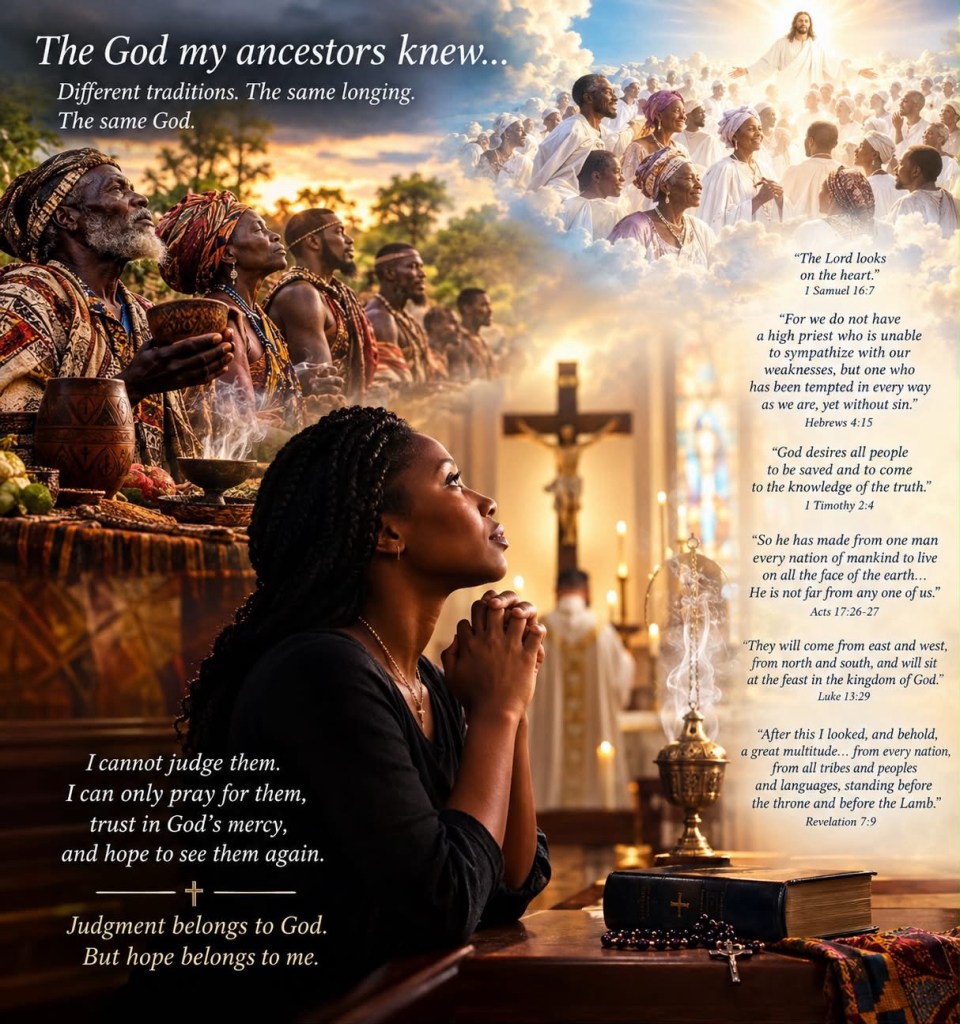
Sometimes, when I sit in church and watch the incense rise toward the ceiling, I think about my ancestors.
I wonder if heaven smells familiar to them.
The priest swings the thurible, and the smoke rises slowly toward the altar. The congregation becomes quiet. Some bow their heads. Some close their eyes. Some pray with their lips moving almost imperceptibly.
And I remember the old people.
The ones who poured libation.
The ones who stood beneath the African sky and called upon the names of those who came before them. The ones who offered incense, made sacrifices, sought forgiveness, asked for protection, and gathered as a community to acknowledge that there was something greater than themselves.
They did not call it Catholicism.
They did not know the Mass.
They did not have the Rosary.
They did not kneel before a crucifix.
But when I look at some of the things they practiced, I see something strangely familiar.
I see reverence.
I see incense.
I see offerings.
I see prayer.
I see thanksgiving.
I see people seeking forgiveness and reconciliation.
I see an understanding that our actions matter, that good and evil are not the same, and that there is a moral order beyond what human eyes can see.
I see people trying to reach toward God with the understanding they had.
And one question has stayed with me:
How will God judge them?
That question is not born out of a lack of faith.
It comes from my faith.
Because I believe in a God who is just, but I also believe in a God whose mercy is greater than my understanding.
My ancestors did not have what I have.
They did not have the Catechism.
They did not have the Gospel explained to them as I have heard it.
They did not have churches, priests, Bibles, or the sacraments as I know them today.
They had what they had been taught.
They had the traditions handed down through generations.
They had the wisdom of their elders.
They had their conscience.
They had the world around them.
They had the heavens above them and the earth beneath their feet.
And they sought answers.
They sought protection.
They sought forgiveness.
They sought peace.
They sought the Creator.
And I cannot stop wondering whether God heard them.
Scripture gives me reason to believe that God judges more deeply than human beings can.
The Bible says, “The Lord looks on the heart” (1 Samuel 16:7).
Not merely the ritual.
Not merely the outward appearance.
Not merely the name someone knew Him by.
The heart.
Paul says something even more striking in Romans 2. He speaks about people who did not possess the revealed law, yet whose conscience could still bear witness to what was right and wrong. He says that God will judge the secrets of the human heart (Romans 2:14–16).
That makes me pause.
Because perhaps God knows things about my ancestors that I will never know.
He knows what they were taught.
He knows what they were never taught.
He knows what they understood.
He knows what they misunderstood.
He knows what was done in ignorance.
He knows what was done knowingly.
He knows the difference between a heart deliberately rejecting God and a heart desperately searching for Him without knowing exactly where to find Him.
Paul once stood before people who worshipped without fully knowing the God they sought. And he told them about “the God who made the world and everything in it.” He told them that God was not far from them.
“He is not far from any one of us” (Acts 17:27).
I think about that often.
Perhaps God was not far from my ancestors either.
Perhaps when they looked toward the heavens, He saw what they could not yet understand.
Perhaps when they poured libation, He saw the longing underneath the ritual.
Perhaps when they burned incense, He saw hearts trying to reach toward the unseen.
Perhaps when they asked for forgiveness, God heard the cry beneath their words.
I am not saying that everything in African Traditional Religion was therefore identical to Catholicism.
It was not.
And I am not saying that every traditional practice was right.
Traditions, like people, can contain both wisdom and error.
But I have come to understand that Christianity did not create humanity’s longing for God.
That longing was already there.
Human beings everywhere have looked upward.
They have knelt.
They have prayed.
They have offered.
They have mourned their dead.
They have searched for forgiveness.
They have asked why we are here and what happens after we leave.
Perhaps the human heart has always been reaching toward the God who was already reaching toward us.
And then there is the question that perhaps troubles many of us:
What about our grandparents?
What about the people who came before Christianity reached them?
What about the grandfather who poured libation?
What about the great-grandmother who followed the traditions of her people?
What about the great-grandfather who tried to live an honorable life according to the knowledge he had?
Will we see them again?
I cannot promise anyone that.
And neither should I.
Heaven is God’s judgment, not mine.
But neither will I tell you that they are condemned simply because they did not know what I know.
The Apostle Paul tells us that God “desires all people to be saved” (1 Timothy 2:4).
That gives me hope.
And Jesus tells us that those who are entrusted with much are held accountable for much (Luke 12:47–48).
That tells me that God knows the measure of what each person received.
He knows what light came into someone’s life.
He knows what darkness surrounded them.
He knows what they did with the light they had.
So I will not try to take God’s seat.
I will not pronounce judgment on my ancestors.
Instead, I will pray for them.
I will remember them.
I will thank God for the good they gave to the generations that followed.
And I will place their souls into the hands of the God who knows them better than I ever could.
There is another Scripture that gives me comfort.
Paul tells believers not to grieve “as others do who have no hope” (1 Thessalonians 4:13).
Hope.
That word matters to me.
Because I want to believe that death does not have the final word.
I want to believe that the family bonds we experience here are not meaningless.
I want to believe that one day, if God grants me the grace of heaven, I may look across that great multitude and see people whose blood runs through me.
People whose names I know.
People whose names I have forgotten.
People whose stories were never written down.
My grandfathers.
My great-grandfathers.
The generations before them.
And perhaps I will recognize them.
Perhaps they will recognize me.
Scripture gives us a beautiful picture of heaven in Revelation 7:9—a multitude from “every nation, from all tribes and peoples and languages” standing before the throne of God.
Every nation.
Every tribe.
Every people.
Every language.
When I read that, I cannot help but think of Africa.
I cannot help but think of my ancestors.
I cannot help but hope.
Maybe one day, I will stand before God and finally understand everything that I cannot understand now.
Maybe I will understand what happened to the people who came before me.
Maybe I will understand their faith, their mistakes, their struggles, their traditions, and their search for God.
And perhaps, if they are there, I will not ask them why they did not know what I know.
I will simply embrace them.
And I will say:
“Grandfather, you were looking for Him too.”
Because perhaps that is the deepest truth I have learned.
I know the God of my ancestors through the light that I have received.
I know Him through Christ.
I know Him through the Church.
I know Him through Scripture and the sacraments.
But I cannot pretend that I know everything God was doing in the lives of the generations before me.
That belongs to God.
So if you worry about whether your grandparents, your great-grandparents, or your ancestors will be in heaven, do not let fear become the final word.
Pray for them.
Entrust them to God.
Ask God to have mercy on them.
And then live your own life faithfully.
Because the same God who will judge them will judge us.
And He will not judge according to our assumptions about one another.
He will judge with perfect knowledge.
Perfect justice.
And perfect mercy.
I cannot tell you that I will definitely see my ancestors in heaven.
But I can tell you this:
I hope I will.
I hope that the God I worship today is the same God they were reaching for yesterday.
I hope that the prayers they whispered beneath the African sky were heard by the same Father to whom I pray today.
I hope that when I finally see heaven, I will discover that God’s mercy was far greater than my fears.
And until that day comes, I will leave my ancestors where they belong:
in the hands of God.
I will not condemn them.
I will not forget them.
I will pray for them.
And I will hope.
Because judgment belongs to God.
But hope belongs to me.
And perhaps, one beautiful day, by the grace and mercy of God, I will walk through the gates of heaven and find that the people I thought I had lost were never truly lost to Him.
Perhaps I will see my grandfathers again.
Perhaps I will see my ancestors.
And perhaps, standing together before the throne of God, we will finally understand the mystery that none of us could fully understand on earth:
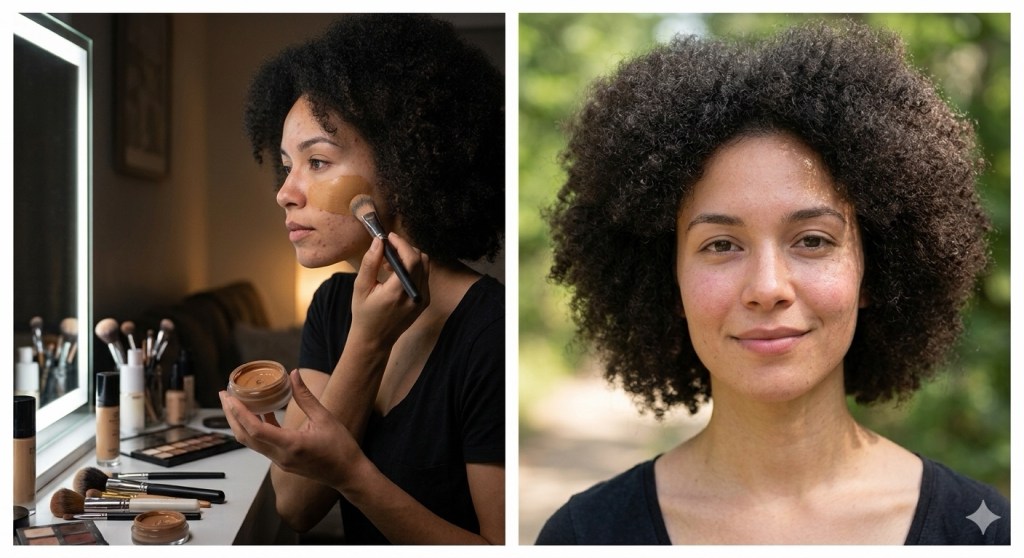
The cosmetic counter at the front of the department store was a temple of transformation. On one side of the glass partition stood Maya, a woman who viewed makeup not as a luxury, but as essential armor. Maya suffered from severe, cystic acne and deep hyperpigmentation. For her, the thick layers of full-coverage foundation and color-correcting primers weren’t about vanity; they were about survival. Without her face put on, the world looked at her with pity or disgust. Makeup gave her the ability to walk into a room and simply be seen as normal. She needed it to navigate a world that judges the book entirely by its cover.On the other side of the counter stood Elena, her closest friend, who wore absolutely nothing on her skin. Elena possessed a natural, effortless glow and had never felt the societal pressure to paint over her features. She looked at Maya’s morning ritual with a mix of confusion and pity. Elena would often argue that we shouldn’t have to alter our faces just to exist in public, advocating for raw, unblemished authenticity. To Elena, makeup was a prison. To Maya, it was a shield.But the deeper question remained: Why do humans collectively feel this desperate need for artificial enhancement? Whether to mask an insecurity, project a version of perfection, or use the face as a canvas for artistic expression, cosmetics have become inextricably linked to human identity. We use it to reclaim control over how we are perceived by the people around us.However, the armor Maya wore so faithfully carried a silent, toxic price tag. Over the months, the very products she used to hide her blemishes began to betray her. It started with a localized, angry redness ; severe contact dermatitis that left her skin burning and flaking beneath the heavy concealer. Desperate to hide the irritation, she applied even more product, trapping a cocktail of harsh synthetic chemicals, heavy metals, and synthetic fragrances against her compromised skin barrier.The truth about the cosmetic industry is rarely beautiful. Beneath the elegant branding and gold-embossed packaging lies a highly unregulated landscape of hazardous formulations. Long-term, daily exposure to certain parabens, phthalates, and formaldehyde-releasing preservatives can alter endocrine function. For Maya, the wake-up call came when a routine dermatology biopsy of a persistent, changing lesion near her jawline revealed the early stages of basal cell carcinoma. While skin cancer can have many triggers, her dermatologist pointed directly to years of clogging her skin pores with low-grade, unregulated cosmetics containing hidden heavy metals and chemical irritants. The very armor she used to face the world was slowly poisoning her from the outside in.Maya was ultimately forced to strip the paint away, standing bare and vulnerable before a world she had spent a lifetime hiding from. In doing so, she and Elena both realized that true care isn’t found in a bottle of foundation and the most dangerous hazards are the ones we willingly apply to our own skin just to fit in.
FOOT NOTES:
Scriptural Reflections on Identity: Remember that you are explicitly designed by the Creator. Psalm 139:14 reminds us, “I will praise thee; for I am fearfully and wonderfully made: marvellous are thy works.” You are beautiful and wonderfully made exactly as you are. Complementing this, Ephesians 2:10 reminds us that we are His workmanship, created with inherent value that no external product can add to or take away.
Author’s Disclaimer and Advice: This story represents my personal opinion and is not an attack on any cosmetic company or the use of makeup itself.
There is absolutely nothing wrong with using makeup if you feel you need it or enjoy it. However, loving yourself means protecting yourself. Always prioritize your health by looking out for what you put on your body, being careful with product choices, and making it a firm habit to thoroughly wipe off and clean your skin properly before you go to bed.
By Joan A. Roberts
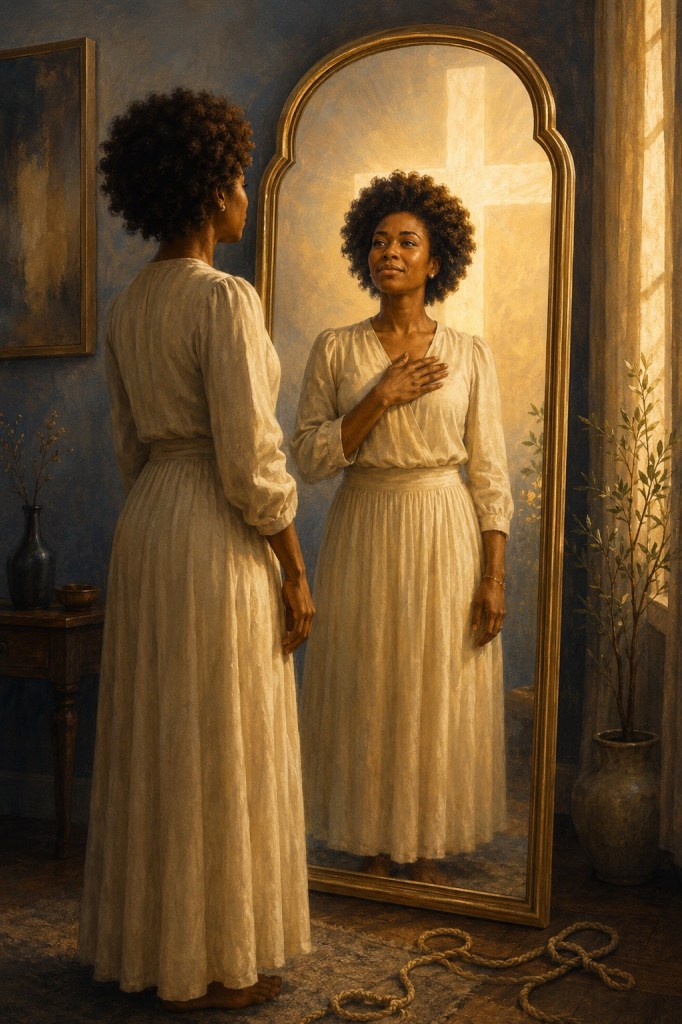
Our beauty, superficially, may be on onlooker but, it’s beyond the reflection in the mirror.It’s your daily affirmation, assertion and faith in your becoming!
I looked at her and smiled. “You know, I really like it when you speak like an adult. You’re barely seven.”
She was growing before my eyes. She was beginning to see me as more than the person who made her meals, took her to school, and provided whatever she needed. “Mommy, what did you do at work today? Did you eat well?”
“You know what? You just put a smile on my face. Let’s go to McDonald’s.”
“Yay!”
Later she asked, “Is Daddy home now?”
“I don’t know. Let me call him.”
He answered. “I’ll be home in a bit. Where’s my angel?”
“She’s right here, smiling from chin to chin.”
“Why?”
“I took her to McDonald’s.”
“Really? Where are you guys? I’ll meet you. We can go have dinner somewhere.”
“Not so fast. I’m making dinner today.”
Abigail interrupted before we could continue. “Mommy, what about the toy you promised me?”
Of course she remembered.
We still had one more stop. I needed to make a payment at the furniture store that I had missed the previous week because I had been ill. I went inside, made the payment, came back out, and reached for the car.
Nothing.
I tried again.
Nothing.
“Oh, Lord Jesus. What is happening?”
The car had been serviced only a few months earlier. I know how to drive a car. I know when it needs gas. Beyond that, my mechanical expertise becomes prayer.
I tried my husband. The call would not go through. Strange, because I had just spoken with him. I tried my mechanic. Nothing.
Before I could finish wondering why I had ever allowed anyone to convince me to become a Toyota person when I had always considered myself more of a Mercedes woman, a man walked toward me.
“I saw you inside the store,” he said. “I work there, but I wasn’t the person helping you, so I minded my business. Do you mind if I take a look at your car?”
“You know about cars?”
He smiled. “A little more than a little.”
At that point, that was enough qualification for me.
He began checking under the hood. As he worked, he told me he had once worked in an auto shop and had been very good at what he did. Then life happened. One job ended after he accepted something from a customer without realizing it violated company rules. At another job, he said a coworker made an accusation against him after he corrected her for repeatedly coming late. Three jobs in six months.
“My wife stays home with the children,” he told me. “We have a daughter around your daughter’s age, a son, and she’s pregnant now. I wanted her home while they were little.”
Then his phone rang.
He looked at the screen. “It’s my wife.”
For one second, I thought, Oh dear. He’s going to have to leave now.
He answered immediately. “Honey, do you need me right now? If you need me, I’ll leave what I’m doing and come.”
“No, honey,” she said. “I’m just checking on you.”
“Is the baby kicking? Do you need to go to the hospital?”
“No. I’m fine. What are you doing?”
“I’m helping a woman with her car so she can get back to her husband and get on with her business.”
There was a pause.
Then he laughed.
“What did she say?” I asked.
He shook his head, smiling. “She said, ‘God bless you for helping another woman.’ Then she asked if you were married.”
I laughed. “Why did she ask that?”
He laughed again. “She said she was just making sure her boy still had eyes only for her.”
“And what did you tell her?”
“I told her, ‘Of course. I’m forever yours.’”
I liked his wife immediately.
“She’s teasing you,” I said, “but she’s also reminding you that she’s waiting for you when you’re done.”
“Exactly.”
“My husband and I do things like that too. We look out for each other. We help each other stay out of temptation.”
He stopped what he was doing for a second and looked at me. “Really?”
“Of course. Temptation will always exist. There are beautiful women everywhere. There are handsome men everywhere. Commitment doesn’t mean we stop noticing that people exist. It means we consciously protect what we chose.”
He smiled. “Now I really want to meet your husband.”
“That is a story for another day. Next time I come to make my furniture payment, perhaps I’ll bring him. If I don’t, I’ll tell you the story.”
He went back to the car.
“Are you almost done?”
“Yes. It looks worse than it is. It’s a minor problem.”
A few moments later he stepped away. “Try it now.”
The car started.
“Oh my goodness. Thank you.”
I reached for my purse.
“No,” he said immediately.
“Please, let me give you something.”
“No. The last time I accepted something from a customer, I got into trouble. I don’t know the rules here, and I’m not taking the chance. I’m just glad I could help.”
That stopped me.
Here was a man who had been through his own difficulties, had a pregnant wife and children waiting for him, and still had enough compassion left to notice someone else standing beside a broken-down car.
I sat behind the wheel for a moment before driving away.
“God.”
That was almost all I could say.
You never promised that cars would not stop. You never promised that inconvenient things would wait for convenient times. But somehow You have a way of being present inside the inconvenience.
That car could have stopped at my daughter’s school. It could have stopped somewhere on the road. It could have stopped late at night. Instead, it stopped outside a store where a man happened to be working who knew cars, even this particular kind of car.
My husband’s phone would not connect. My mechanic’s phone would not connect. I had said only a little prayer:
“God, please see me through.”
And then a man walked out of a store.
Perhaps someone else would call that coincidence.
Faith has simply taught me to pay attention.
Sometimes God does not remove the problem before it reaches us. Sometimes He places help beside the problem before we even know we are going to need it.
And sometimes the person God uses to help us is carrying a burden of his own.
He fixed my car.
His wife reminded me what partnership could look like.
His story reminded me that suffering does not have to make a person bitter.
And that ordinary afternoon reminded me of something greater:
God was not arriving to rescue me. He was always there By Joan A.Roberts
If the salary was the same, what job would you be doing right now and why?
Tell me, when did a marriage certificate become a woman’s birth certificate?
When did becoming a wife become the beginning of her life?
And when did divorce papers become proof that her life had ended?
Make it make sense.
Do not tell me that my life begins when a man chooses me, or ends when he walks away.
Do not measure my worth by the ring on my hand, the peace within my home, or the name beside mine.
I was a woman before I became a wife. I was God’s daughter before anyone called me his.
I have an identity.
There was a time when I carried another person’s choices as though they were stains upon my own character.
If he wandered, I questioned my beauty. If he broke his promises, I questioned my worth.
If he chose another path, I wondered what was missing in me.
But separation taught me what marriage never could:
Another person’s choices cannot rewrite my character.
What he does belongs to his conscience. What I become belongs to mine.
I have an identity.
I did my part.
I spoke the truth, offered counsel, prayed, loved, and gave what I understood a wife should give.
But a wife is not a judge.
Marriage is not a courtroom where she must spend her life presenting evidence against the person she once promised to love.
His choices belong to him. His choices were never mine to begin with.
His final answer will be given to God, not to me.
I will not lose my peace trying to supervise another person’s soul.
I have children to guide, a calling to answer, a life to live, and a self I have finally learned to know.
I have an identity.
Not one created by marriage. Not one bestowed upon me by a man.
My identity is rooted solely in God.
I will not teach my children to hate their earthly father. I will teach them to know their heavenly Father.
I will tell them about the One who never abandons, never deceives, and never forgets the children He created.
I will sit beside them through their homework.
I will listen to the questions in their hearts.
I will plant the truth of Christ within them and trust God to bring the harvest.
They say divorce is freedom. They say remarriage is a new beginning.
But how can a document give me a freedom I have already found in Christ?
How can another relationship restore a worth I never truly lost?
Make it make sense.
I do not need another person’s arms to prove that I am wanted.
I do not need another marriage to prove that I am whole.
My body is not an abandoned house waiting for a new owner.
It is a temple. It is dignified. It belongs first to the God who formed it.
I do not have to erase him to rediscover myself.
I do not have to replace him to continue living.
I can choose distance without hatred, boundaries without bitterness, and peace without surrendering what I believe.
I can live apart without living outside my conviction.
To me, neither divorce nor remarriage can erase the sacred weight of a covenant while the one I married is still alive.
Court papers may change our addresses, our schedules, and the moments when we meet.
But they cannot make two parents complete strangers.
There will still be school gates. There will still be birthdays.
There will still be small hands carrying two histories into the same room.
There may even be softer days when a familiar voice awakens a memory we thought had gone to sleep.
So tell me, what exactly did the papers erase?
Make it make sense.
Separation gave me distance, but Christ gave me identity.
I no longer tremble before another person’s choices.
I no longer search within myself for the reason someone else went astray.
Marriage did not create me. Divorce cannot erase me.
I have an identity.
Know yourself before someone calls you wife.
Know the God who named you before someone gives you another name.
Marriage may become part of your story, but it was never meant to become the author of your existence.
I was His before I was his.
And whatever happens between two human hearts, my identity begins, remains, and ends in Christ. 🙏
Foot note: In the words of Joyce Meyer, “Love is not a feeling. Love is a decision, and that decision is renewed each day.”
We are human, and our emotions can shift because of something as ordinary as a crying baby, an unanswered phone, a flat tire, an unpleasant smell, or another person’s imperfections.
But temporary feelings do not have the authority to govern how we treat someone we have decided to love for better or for worse.
My decision not to divorce or remarry was not born from passing emotions or the private circumstances of my home. It was a conviction I held before marriage, rooted in God’s Word.
Christianity is not a feel good faith. Marriage may encounter hardship and spiritual warfare, but husband and wife are called to pray, seek godly counsel, and stand in the gap for one another.
“Therefore what God has joined together, let no one separate.” Mark 10:9; see also Mark 10:2–12.
“When you make a vow to God, do not delay to fulfill it.” Ecclesiastes 5:4–5; see also Numbers 30:2 and Ephesians 5:25, 33.