In Part One, I talked about alcohol from the outside—the things it can quietly take from us, the imbalance it can create, and the way something that begins as recreation can gradually demand more than we ever intended to give.
But sometimes statistics and explanations are not enough.
Sometimes we need a story.
So let me tell you about Tamara.
Tamara did not begin as a troubled child.
She came from a family that loved her. She had people around her who had expectations for her life. Like many young people, she was simply growing, discovering herself, wanting friendship, wanting acceptance, and wanting to belong.
And sometimes the desire to belong introduces us to things we never went looking for.
For Tamara, alcohol became part of that world.
At first, it was not presented as destruction.
It was social.
It was what other people were doing.
It was one of those moments where saying yes seemed easier than being the person who said no.
That is one of the dangers we sometimes overlook when we talk about alcohol. We imagine that every destructive relationship with alcohol begins with someone deliberately choosing recklessness.
It does not.
Sometimes it begins with belonging.
One decision becomes another.
One environment leads into another.
And eventually Tamara found herself in circumstances she had never imagined for herself.
Alcohol impaired her judgment and compromised her ability to protect herself.
Then something happened that should never have happened.
Tamara was sexually violated.
Let me make something very clear here:
Alcohol does not make sexual assault acceptable.
Being intoxicated does not transfer responsibility for another person’s violation onto the person who was violated.
Tamara had made decisions that placed her in a vulnerable situation. She would eventually have to examine those decisions honestly.
But another person’s decision to violate her remained that person’s responsibility.
Both truths can exist in the same story.
And then came another reality.
Pregnancy.
Suddenly, what had begun as drinking with peers was no longer simply a night, a party, or a mistake that could disappear with the morning.
There were consequences that followed her home.
There were conversations.
There was pain.
There was shame.
There was fear.
There were decisions that had to be made.
Her life had reached the heavier side of the seesaw.
But that was not the end of Tamara.
Her family intervened.
She received treatment.
Her environment changed.
She changed schools.
The people around her began helping her rebuild structure around a life that had begun slipping beyond her control.
And Tamara also had work to do.
Restoration does not mean pretending our decisions never happened.
Grace and accountability are not enemies.
Sometimes grace is precisely what gives us enough courage to look at ourselves truthfully without deciding that our worst chapter must become our entire identity.
Tamara had to learn.
Her family had to learn.
There were consequences that could not simply be erased.
But there was also something else:
another chance.
That is the part of these stories I never want us to forget.
We can talk about what alcohol takes without deciding that the person from whom something has been taken is permanently lost.
We can warn without condemning.
We can teach without humiliating.
We can hold people accountable without stripping them of dignity.
And we can recognize that sometimes what looks like rebellion from the outside is a human being standing at an intersection of pressure, vulnerability, poor decisions, trauma, and an enormous need to belong.
The Bible says:
“Though a righteous person falls seven times, he will get up.” — Proverbs 24:16
The emphasis is not merely on the falling.
It is on the getting up.
Tamara got another opportunity to get up.
And perhaps someone reading this needs one too.
Maybe alcohol has already taken something from you.
Maybe your story is not alcohol.
Maybe yours has another name entirely.
Whatever it is, acknowledging what happened is not the same thing as surrendering your future to it.
You can examine your choices.
You can accept help.
You can change your environment.
You can rebuild.
You can return to God.
And you can begin again.
Because sometimes the most important thing about the heavier side of the seesaw is discovering that the weight does not have to remain there forever.
Joan A. Roberts Divine Accolades — Words & Wellness
It is easy to reduce the conversation about alcohol to one sentence:
“Alcohol is bad.”
Or, in Christian circles:
“Drinking is a sin.”
But sometimes a statement can be so brief that the person hearing it never gets the opportunity to understand the deeper question:
What does alcohol actually take from us?
And perhaps there is another question hiding underneath that one.
Why do people continue along certain paths even when they already know the possible devastation and consequences?
Why does knowing that something can damage the body, alter judgment, destroy relationships, disrupt families, interfere with purpose, or derail a future not always stop a person from doing it?
Why do human beings sometimes continue behaviors they themselves recognize as destructive?
Perhaps—just perhaps—the message was heard, but never understood deeply enough to challenge the reasoning behind the behavior.
Perhaps we sometimes tell people what not to do without helping them understand why.
Perhaps the message was never strong enough to provoke thought, challenge reasoning, educate the mind, awaken the conscience and speak to the soul.
Because information that merely frightens a person may eventually be forgotten.
Condemnation may produce shame without producing understanding.
But understanding can cause someone to stop long enough to ask:
What is this actually doing to me?
That is the conversation I want to have.
I am not asking these questions to judge the person holding a glass.
Neither am I interested in standing at a distance, pointing toward another person’s struggle and declaring myself more righteous.
I am asking because alcohol does something.
It does something chemically.
It does something neurologically.
It can affect behavior.
Judgment.
Coordination.
Memory.
It can affect the organs of the body.
And from my Christian perspective, anything capable of repeatedly interfering with judgment, consciousness and self-control deserves another question:
What might this also be doing to my spiritual vigilance?
BEYOND THE BOTTLE-
There are many dramatic claims surrounding alcohol.
Claims about the origin and ancient meaning of the word alcohol.
Claims connecting gin with jinn.
Claims about why alcoholic beverages are called spirits.
Claims connecting certain bottles, symbols, secret societies and occult practices.
Some of these claims are repeated so frequently that they begin to sound established.
But many are disputed, historically unsupported, or simply inaccurate.
And perhaps we don’t need them.
Because what we already know about alcohol is serious enough.
Alcohol acts on the central nervous system.
As intoxication increases, inhibition can decrease. Judgment may become impaired. Coordination and reaction time can deteriorate.
Memory can also be affected.
During an alcohol-related blackout, a person may remain awake.
The person may speak.
Walk.
Interact with other people.
Make decisions.
Yet during portions of that period, the brain may fail to properly form new memories.
Later, the person may genuinely have gaps in what they remember.
Think about that for a moment.
The body was present.
The person was interacting with the environment.
Yet portions of the experience were not being properly stored as memories.
That alone should provoke thought.
And alcohol does not stop with the brain.
Chronic heavy alcohol use can damage the liver.
Repeated injury may lead to inflammation and fibrosis. Over time, cirrhosis can develop, with extensive scarring and distortion of normal liver architecture.
The consequences of excessive alcohol use can reach other systems of the body as well.
So when I speak about alcohol spiritually, I am not replacing medicine with religion.
I am looking at the whole human being.
Body, Mind and Spirit
I believe the human being is more than a collection of organs.
We have a body.
We have a mind.
And I believe we possess a spiritual life.
Therefore, when something can alter consciousness, judgment, inhibition, memory and self-control, I cannot examine only what it does to the liver or brain.
I also have to ask:
What is it doing to the person?
As a Christian, sobriety means something to me.
Vigilance means something.
Discernment means something.
Self-control means something.
The ability to experience an appetite and still tell that appetite no means something.
The ability to recognize temptation without automatically obeying it means something.
This is why one particular passage of Scripture arrests my attention:
“All things are lawful for me, but I will not be dominated by anything.”
1 Corinthians 6:12
Dominated.
That is a powerful word.
Sometimes we spend so much time asking,
Can I do this?
that we forget to ask,
Is this beginning to master me?
And perhaps another question:
What am I becoming while I continue doing it?
There is an important distinction here.
Medicine can demonstrate alcohol’s effects on the nervous system, judgment, memory, behavior and organs.
Medicine has not demonstrated that alcohol literally removes the Holy Spirit from someone’s body or inserts a demonic spirit into a person.
Those are spiritual interpretations rather than established neurological findings.
But my Christian concern remains.
Scripture repeatedly calls us toward sobriety.
Vigilance.
Discernment.
Self-control.
And toward a life in which appetite does not become master.
Which brings me to something I learned very young.
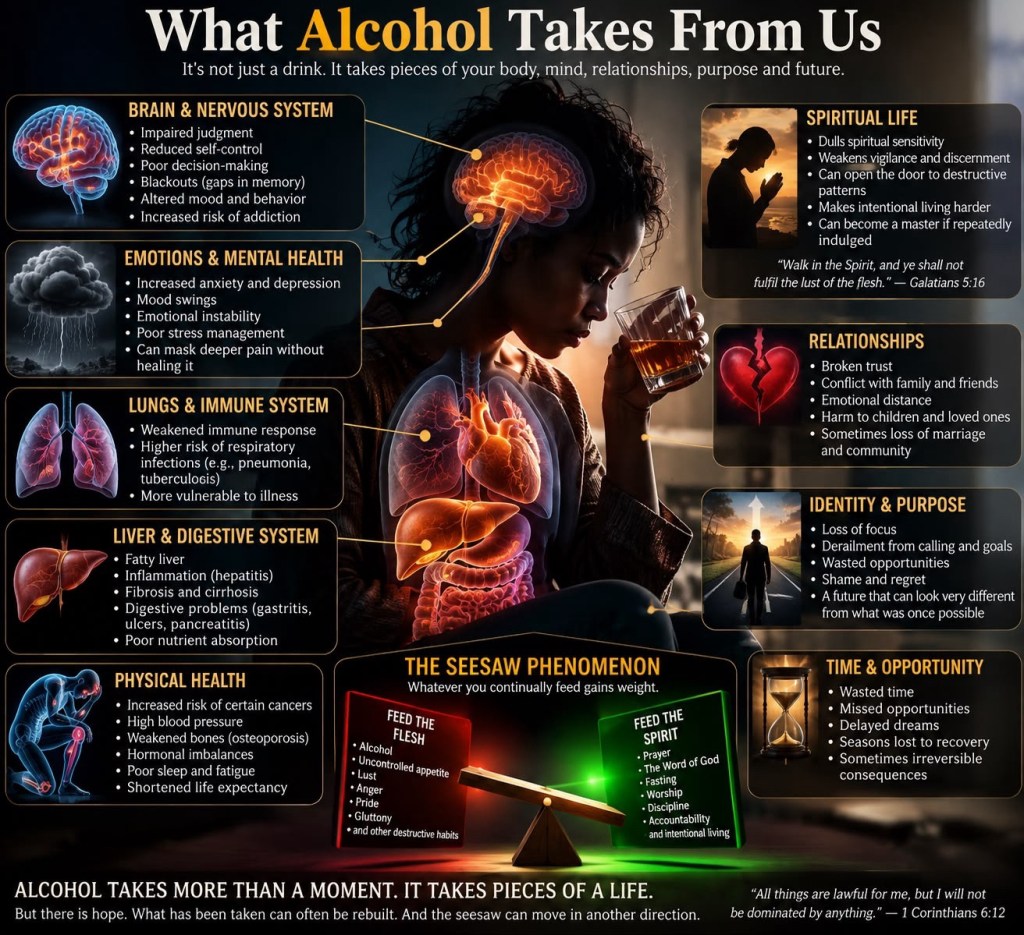
THE SEESAW PHENOMENON-
I first understood what I now call the seesaw phenomenon In my early twenties “.
The simplest picture I have found for this is a seesaw.
And I have carried this picture for a very long time.
Like I earlier mentioned. I first caught this revelation or what I call the seesaw, phenomenon, in my early twenties.
I was very young.
But that simple revelation has, in no small measure, influenced my decision to live intentionally every day.
It taught me something I have never forgotten:
The mere declaration that I am a Christian is not enough. There must also be intentional Christian living.
Faith must be fed.
The spirit must be fed.
Because whatever side I continually feed becomes heavier.
If I continually feed appetite without restraint—whether through alcohol intoxication, sexual excess, uncontrolled anger, lust, gluttony, pride, or another uncontrolled desire—the flesh becomes heavier.
But if I continually feed my spirit through prayer, the Word of God, fasting, retreat, worship, discipline, obedience and simply remaining in His presence, my spirit becomes stronger.
The picture is simple:
Whatever I continually feed gains weight.
This is why the words of Paul in Galatians make such profound sense to me:
“Walk in the Spirit, and ye shall not fulfil the lust of the flesh.”
— Galatians 5:16
Walk.
Not visit.
Not occasionally remember.
Walk.
There is continuity in walking.
There is intention in walking.
There is movement.
One step followed by another.
In comparative terms, using my seesaw illustration, when the spirit man becomes the heavier side, the direction of one’s life increasingly follows the Spirit.
The flesh may still speak.
Temptation may still come.
Appetite may still knock.
But everything that knocks does not have to be given entrance.
And that kind of spiritual weight does not develop accidentally.
It comes with intention.
Consistency in prayer.
Consistency in the Word.
Consistency in fasting.
Consistency in retreat.
Consistency in worship.
Consistency in seeking His presence.
Consistency in choosing again tomorrow what you chose today.
Over time, living by the Spirit becomes more than something we profess.
It becomes the direction in which we have trained our lives to move.
And the opposite deserves equal attention.
Whatever we repeatedly feed in the flesh also gains weight.
One indulgence.
Then another.
One compromise.
Then another.
One secret.
Then another.
Until something we once believed we controlled begins attempting to control us.
Perhaps that is why simply saying “alcohol is bad” has never felt like enough of a conversation to me.
I want to know:
What does it affect?
What does it weaken?
What does it alter?
What am I feeding?
What am I strengthening?
What am I allowing to become heavier?
And ultimately:
What is becoming master?
Because the seesaw does not move according to what we merely profess.
It moves according to weight.
And weight is accumulated.
Choice by choice.
Habit by habit.
Day by day.
Whatever I continually feed gains weight.
And sometimes the easiest way to understand a principle is not through another lecture.
Sometimes you need a story.
And this is where mine begins.
Years ago, when I was much younger, I began thinking about a story.
At the time, I did not have all the language I have now.
I couldn’t explain everything medically.
I couldn’t explain everything spiritually.
But I understood something:
People rarely wake up one morning and decide,
“Today I will destroy everything I believe in.”
Sometimes it begins much more quietly.
One environment.
One invitation.
One compromise.
One secret.
Then another.
And somewhere along the way, one side of the seesaw becomes heavier.
So next let me tell you about Tamara.
To be continued…
The seesaw does not move according to what we merely profess. It moves according to weight.
What Alcohol Takes From Us
Part One
It is easy to reduce the conversation about alcohol to one sentence:
“Alcohol is bad.”
Or, in Christian circles:
“Drinking is a sin.”
But sometimes a statement can be so brief that the person hearing it never gets the opportunity to understand the deeper question:
What does alcohol actually take from us?
And perhaps there is another question hiding underneath that one.
Why do people continue along certain paths even when they already know the possible devastation and consequences?
Why does knowing that something can damage the body, alter judgment, destroy relationships, disrupt families, interfere with purpose, or derail a future not always stop a person from doing it?
Why do human beings sometimes continue behaviors they themselves recognize as destructive?
Perhaps—just perhaps—the message was heard, but never understood deeply enough to challenge the reasoning behind the behavior.
Perhaps we sometimes tell people what not to do without helping them understand why.
Perhaps the message was never strong enough to provoke thought, challenge reasoning, educate the mind, awaken the conscience and speak to the soul.
Because information that merely frightens a person may eventually be forgotten.
Condemnation may produce shame without producing understanding.
But understanding can cause someone to stop long enough to ask:
What is this actually doing to me?
That is the conversation I want to have.
I am not asking these questions to judge the person holding a glass.
Neither am I interested in standing at a distance, pointing toward another person’s struggle and declaring myself more righteous.
I am asking because alcohol does something.
It does something chemically.
It does something neurologically.
It can affect behavior.
Judgment.
Coordination.
Memory.
It can affect the organs of the body.
And from my Christian perspective, anything capable of repeatedly interfering with judgment, consciousness and self-control deserves another question:
What might this also be doing to my spiritual vigilance?
BEYOND THE BOTTLE-
There are many dramatic claims surrounding alcohol.
Claims about the origin and ancient meaning of the word alcohol.
Claims connecting gin with jinn.
Claims about why alcoholic beverages are called spirits.
Claims connecting certain bottles, symbols, secret societies and occult practices.
Some of these claims are repeated so frequently that they begin to sound established.
But many are disputed, historically unsupported, or simply inaccurate.
And perhaps we don’t need them.
Because what we already know about alcohol is serious enough.
Alcohol acts on the central nervous system.
As intoxication increases, inhibition can decrease. Judgment may become impaired. Coordination and reaction time can deteriorate.
Memory can also be affected.
During an alcohol-related blackout, a person may remain awake.
The person may speak.
Walk.
Interact with other people.
Make decisions.
Yet during portions of that period, the brain may fail to properly form new memories.
Later, the person may genuinely have gaps in what they remember.
Think about that for a moment.
The body was present.
The person was interacting with the environment.
Yet portions of the experience were not being properly stored as memories.
That alone should provoke thought.
And alcohol does not stop with the brain.
Chronic heavy alcohol use can damage the liver.
Repeated injury may lead to inflammation and fibrosis. Over time, cirrhosis can develop, with extensive scarring and distortion of normal liver architecture.
The consequences of excessive alcohol use can reach other systems of the body as well.
So when I speak about alcohol spiritually, I am not replacing medicine with religion.
I am looking at the whole human being.
Body, Mind and Spirit
I believe the human being is more than a collection of organs.
We have a body.
We have a mind.
And I believe we possess a spiritual life.
Therefore, when something can alter consciousness, judgment, inhibition, memory and self-control, I cannot examine only what it does to the liver or brain.
I also have to ask:
What is it doing to the person?
As a Christian, sobriety means something to me.
Vigilance means something.
Discernment means something.
Self-control means something.
The ability to experience an appetite and still tell that appetite no means something.
The ability to recognize temptation without automatically obeying it means something.
This is why one particular passage of Scripture arrests my attention:
“All things are lawful for me, but I will not be dominated by anything.”
1 Corinthians 6:12
Dominated.
That is a powerful word.
Sometimes we spend so much time asking,
Can I do this?
that we forget to ask,
Is this beginning to master me?
And perhaps another question:
What am I becoming while I continue doing it?
There is an important distinction here.
Medicine can demonstrate alcohol’s effects on the nervous system, judgment, memory, behavior and organs.
Medicine has not demonstrated that alcohol literally removes the Holy Spirit from someone’s body or inserts a demonic spirit into a person.
Those are spiritual interpretations rather than established neurological findings.
But my Christian concern remains.
Scripture repeatedly calls us toward sobriety.
Vigilance.
Discernment.
Self-control.
And toward a life in which appetite does not become master.
Which brings me to something I learned very young.
THE SEESAW PHENOMENON-
I first understood what I now call the seesaw phenomenon In my early twenties “.
The simplest picture I have found for this is a seesaw.
And I have carried this picture for a very long time.
Like I earlier mentioned. I first caught this revelation or what I call the seesaw, phenomenon, in my early twenties.
I was very young.
But that simple revelation has, in no small measure, influenced my decision to live intentionally every day.
It taught me something I have never forgotten:
The mere declaration that I am a Christian is not enough. There must also be intentional Christian living.
Faith must be fed.
The spirit must be fed.
Because whatever side I continually feed becomes heavier.
If I continually feed appetite without restraint—whether through alcohol intoxication, sexual excess, uncontrolled anger, lust, gluttony, pride, or another uncontrolled desire—the flesh becomes heavier.
But if I continually feed my spirit through prayer, the Word of God, fasting, retreat, worship, discipline, obedience and simply remaining in His presence, my spirit becomes stronger.
The picture is simple:
Whatever I continually feed gains weight.
This is why the words of Paul in Galatians make such profound sense to me:
“Walk in the Spirit, and ye shall not fulfil the lust of the flesh.”
— Galatians 5:16
Walk.
Not visit.
Not occasionally remember.
Walk.
There is continuity in walking.
There is intention in walking.
There is movement.
One step followed by another.
In comparative terms, using my seesaw illustration, when the spirit man becomes the heavier side, the direction of one’s life increasingly follows the Spirit.
The flesh may still speak.
Temptation may still come.
Appetite may still knock.
But everything that knocks does not have to be given entrance.
And that kind of spiritual weight does not develop accidentally.
It comes with intention.
Consistency in prayer.
Consistency in the Word.
Consistency in fasting.
Consistency in retreat.
Consistency in worship.
Consistency in seeking His presence.
Consistency in choosing again tomorrow what you chose today.
Over time, living by the Spirit becomes more than something we profess.
It becomes the direction in which we have trained our lives to move.
And the opposite deserves equal attention.
Whatever we repeatedly feed in the flesh also gains weight.
One indulgence.
Then another.
One compromise.
Then another.
One secret.
Then another.
Until something we once believed we controlled begins attempting to control us.
Perhaps that is why simply saying “alcohol is bad” has never felt like enough of a conversation to me.
I want to know:
What does it affect?
What does it weaken?
What does it alter?
What am I feeding?
What am I strengthening?
What am I allowing to become heavier?
And ultimately:
What is becoming master?
Because the seesaw does not move according to what we merely profess.
It moves according to weight.
And weight is accumulated.
Choice by choice.
Habit by habit.
Day by day.
Whatever I continually feed gains weight.
And sometimes the easiest way to understand a principle is not through another lecture.
Sometimes you need a story.
And this is where mine begins.
Years ago, when I was much younger, I began thinking about a story.
At the time, I did not have all the language I have now.
I couldn’t explain everything medically.
I couldn’t explain everything spiritually.
But I understood something:
People rarely wake up one morning and decide,
“Today I will destroy everything I believe in.”
Sometimes it begins much more quietly.
One environment.
One invitation.
One compromise.
One secret.
Then another.
And somewhere along the way, one side of the seesaw becomes heavier.
So next let me tell you about Tamara.
To be continued…
The seesaw does not move according to what we merely profess. It moves according to weight.
There are days I don’t want to stay inside my house.
Not because I have somewhere important to be. Not because I am chasing anything urgent.
Just… because I don’t want to be there.
The walls start to feel louder than people. My thoughts start to feel too close. And even silence begins to feel like pressure instead of peace.
So I leave.
I tell myself I just need a change of scenery. A place where nobody knows me. A place where I can sit, breathe, think, and not be needed by anyone for a while.
Coffee shop. Fast food place. Anywhere with a chair. Somewhere between being home and being nowhere.
But what I forget every time is this:
Public places are not escape rooms.
They are living systems.
People are always asking. Machines are always ringing. Orders are always being called out like small interruptions to your thoughts.
And somehow… I always end up in the middle of it.
Sitting down like I’m invisible… but also fully present in a world that refuses to be quiet.
I open my books anyway. I try to study anyway. I try to convince myself that I can create stillness in motion.
But I haven’t yet learned what this place really is.
Not peace. Not escape.
Just life happening loudly around me while I pretend I’m not part of it.
And still… I sit there.
Not fully understanding why I keep choosing these seats.
And maybe… it is not always about me at all.
Sometimes it is because your presence in a place, at a specific time, might be the quiet interruption someone else did not know they needed. A reminder that they are still seen. Still human. Still capable of believing in themselves again… or finding a reason to keep going.
People don’t usually arrive in your life with meaning attached.
They arrive in fragments, standing in line, holding a phone, shifting weight from one foot to the other, waiting for coffee, waiting for food, waiting for something that isn’t you.
And then it happens.
A glance. A pause. A moment where your eyes drift up from whatever you were doing.
“What are you studying for?”
It’s never asked like a question that needs a future. It’s asked like a bridge across silence.
You answer anyway.
You say the name of it. The path. The thing that takes years and feels like it’s always sitting somewhere ahead of you instead of under your feet.
And they react.
“I can’t do it.”
A small laugh sometimes follows—yours or theirs, light, almost polite, as if the sentence needs cushioning to land safely.
Then comes the familiar turn:
“Why don’t you stop?”
And you almost answer honestly, but not fully.
Not because you are hiding the truth; but because the truth doesn’t fit the size of the moment.
So you give them the short version.
“It’s too late now. I’m already far gone.”
Not said like despair. More like a joke you’ve repeated enough times that it learned your tone.
They nod.
And then, the script completes itself:
“Well… I guess you should finish what you started.”
It always circles back there.
As if life decisions can be summarized in a sentence between transactions.
As if commitment is something people recognize instantly when they’re just passing through.
What nobody really sees is what’s happening underneath.
Because you’re not actually having a conversation about studying.
You’re standing in the middle of two worlds at once:
One is loud and immediate; people, orders, movement, time passing in small pieces.
The other is internal, built from repetition, pressure, goals, exhaustion, and quiet persistence.
And those two worlds don’t translate cleanly in thirty seconds.
So most of the time, you let it be light.
You let it pass through you the way background noise does.
Because you’ve learned something important:
Not every sentence offered to you is meant to be carried.
Some are just air that happened to pass your direction.
Still, there’s something interesting about these small encounters.
They reveal how people think when they are not trying to think deeply at all.
How they fill space.
How they reflect themselves in your story without meaning to.
Some see ambition.
Some see burden.
Some see possibility.
And most just see a conversation that will end when their turn arrives.
And maybe that’s the real quiet truth:
Not every moment is a message.
Some are just passing weather.
You can acknowledge it, and still keep walking your own direction.
Because at the end of the day, your story isn’t written in the waiting room. By Joan Roberts
Children watch. They see. They observe. They learn and model what they see.
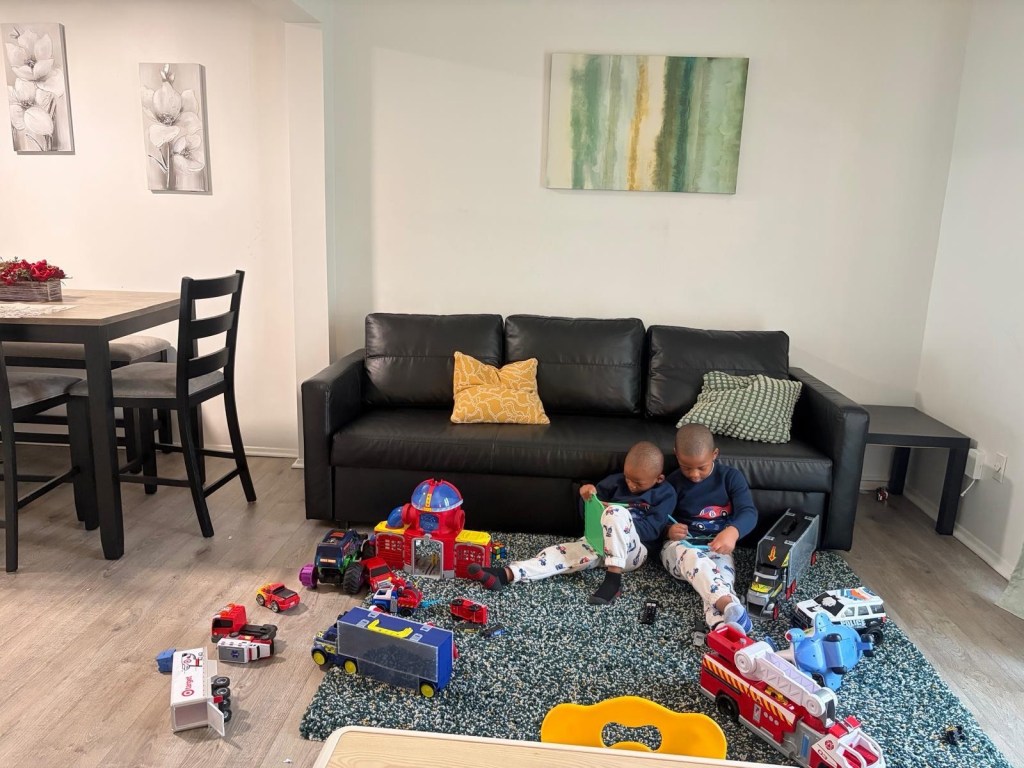
I was a student while my boys were in my womb. Sometimes, when I was pregnant with them, I read aloud and prayed aloud. Later, they saw me studying on my days off from work. Mummy always has one or two exams to write! They saw me with my big textbooks, and they saw me go to work.
I wanted reading and learning to feel like parts of life, not chores. At first, I wondered if I should give them more cartoons, more games, and more trips to the park. I did not want them to become just like me. I wanted them to enjoy learning for their own sake. So I introduced it gradually, day after day.
On weekends, I take them to the library. There is a children’s section for reading and a separate little area with Legos, games, and toys. While they play, I have my book too, keeping one eye on them and the other on the page. They know their mom is an avid reader, and I think they have taken after me.
I read to them every day when I can, sometimes two or three books in a night or during the day. Weekdays are usually for bedtime stories; on weekends and holidays, we read during the day. We have tried online books, but now we have gone back to real, physical books. When the boys are home, they keep me busy reading to them. Sometimes they want another book before I have had enough time for my own reading.
My older son loved bedtime stories. Sometimes, after I put him to bed, he would get up, find a book, and try to read under the lamp. He was itching for the next page, trying to decipher the words on his own. He would study one line, then another, and sometimes try to hide the book under his pillow.
Teachers would ask me, “Do you know your child can read?”
“Yes,” I would say.
One teacher told me my child was among the one percent of students in the class who could read and write. “I don’t doubt that,” I said. They looked at me as though I did not understand how remarkable it was. I looked back, wondering why they were so surprised. I knew how much I had read to him and how I had taught him to write.
But my older son did surprise me.
One day, I was going to pick up my youngest son, and I picked up my older son first. My older son told me to go pick up his younger brother. Then he surprised me by asking if he could write me a letter. An adult gave him paper and a pen. He wrote, “Mommy, I love you every day and all day.”
I tried to hold myself together, but I burst out laughing, and the tears rolled down my face. I was glad I had managed to keep my decorum in public. I went home and laughed on the floor. That little letter nearly gave me a cardiac arrest—in the best way.
I had been reading with them, practicing letters and spelling, trying simple weekend mathematics, showing them a bit of the world map and teaching them about planets, and saying prayers and Psalms with them. I did not know how those little moments were adding up. I was simply encouraging them, day after day.
I want my boys to become their own people. I do not want to push them into being who I am, but I also do not want to underestimate what they can do. When a child becomes interested, I believe in a gentle nudge and giving them room to explore.
There is time for everything: school, reading, play, parks, swimming, singing, holidays, meals, sleep, and prayer. Learning belongs in that life, too. To me, the earlier children discover that learning can be enjoyable, the better.
I have heard that children learn from the womb. I am beginning to see that in my own life. Sometimes, when I was pregnant with my boys, I read aloud and prayed aloud. Now I see how curious they are, and they are doing well with their milestones. I would not be surprised if one day they became professors, writers, or something along those lines.
I was giving my boys gentle encouragement, never knowing one of those moments would surprise me so much that I would laugh until I cried. By Joan Roberts
Foot note:
Proverbs 22:6
Train up a child in the way he should go and when he is d he shall not depart from it.
It’s at the early primordial stage children learn better, whatever they will someday imbibe as a habit that would look like their own regardless of the interplay of nature vs nurture.
It’s often a what you sow it’s what you reap.
I would add prayer is unavoidable in bringing up children after Gods own heart as well as teaching them elements of a successful life.
Father, we begin with praise and worship. We honor You as God—faithful, near to the brokenhearted, and present in every moment we cannot understand.
Lord, today we lift up every person who feels overwhelmed, weary, lonely, misunderstood, or unseen.
Those walking through depression and emotional pain. Those grieving the loss of loved ones. Those facing separation, divorce, or broken relationships. Those struggling financially—wondering how to provide food, shelter, or stability. Those facing rejection, judgment, or silence in their homes, workplaces, and communities.
Father, You see them all.
And Lord, for anyone who has even thought about giving up—step into that moment. Bring light into the darkest places. Bring peace where anxiety has taken root. Bring hope where everything feels like it is falling apart.
Remind them, Lord, that their life is not forgotten and their story is not finished.
Help them breathe again. Help them believe again. Help them hold on again.
Father, teach us to be patient with You. Teach us to trust Your timing even when we do not understand Your process. And teach us to have faith in You when life feels uncertain.
Help us to believe that every storm, every twist and turn, every unpleasant circumstance is not a detour from our destiny, but an opportunity—to learn, to grow, and to become a greater version of ourselves in You.
And Lord, teach us to see differently. That what looks ugly in the moment is not the end of the story.
Help us understand that even the uncomfortable seasons, the painful delays, the things we did not ask for, are not wasted in Your hands.
You are still shaping us in it. Still forming us through it. Still building something greater in us because of it.
Not everything that feels like breaking is destruction—sometimes it is becoming.
So teach us to trust the process of becoming. To believe that what You are doing in us is deeper than what we can see around us.
And that in the end, even this will carry Your glory—and reveal a stronger, wiser, more rooted version of who You created us to be.
Help us to embrace You in the process and use even our pain for Your glory in the end.
Lord, heal the places where disappointment has hardened our hearts. Heal the places where silence made us feel abandoned. And heal the places where delay made us question Your love.
Help us stop placing ultimate expectations on people—parents, spouses, friends, or leaders—when only You are perfect and complete.
Teach us to honor people for what they are, but to anchor our hope in You alone.
Lord, strengthen the one who is tired. Uplift the one who feels stuck. Restore the one who feels forgotten. And surround the one who feels alone.
Let Your peace rest upon every heart that reads or hears this prayer.
And when we cannot see the way forward, help us to still trust Your hand.
In Jesus’ name, Amen.
⸻
SCRIPTURE REFERENCES
Romans 8:28 — “And we know that all things work together for good to them that love God, to them who are the called according to His purpose.”
Philippians 4:13 — “I can do all things through Christ which strengtheneth me.”
Hebrews 12:2 — “Looking unto Jesus the author and finisher of our faith…”
Matthew 6:33 — “But seek ye first the kingdom of God, and his righteousness; and all these things shall be added unto you.”
Hebrews 11:6 — “But without faith it is impossible to please him…” By Joan A.Roberts Honestly led by the spirit of God.
I was taught a high level of reservation back in Africa.
Not silence, but restraint. A sense that not everything that happens in your life is meant to be spoken out loud, especially to people who are not part of your inner circle.
Now I find myself in a different culture where almost anything can be said in passing.
At Walmart, in a line, someone might casually say, “My wife is going through the same thing, she was just diagnosed with cancer.” No hesitation. No pause. As if personal history can sit comfortably between grocery carts and checkout lines.
And I sometimes find myself asking quietly: who asked for this level of detail?
Not out of judgment, but out of confusion.
Because I am used to a different rhythm.
Even overhearing conversations can feel unfamiliar. A spouse on the phone might start with “I’m going to see my dad,” and then continue into diagnoses, medications, history; details that feel deeply personal being shared in full volume with someone outside the immediate circle.
And I think again: who was that for?
Where I come from, things were often contained. Not hidden, but held.
Trips were not announced in full detail. Neighbors might only see you leave after you had gone, and see you return when you returned. Life was not always performed in real time for the outside world.
There was a sense that privacy was protection, not secrecy.
Now, I am learning that some cultures process life differently.
In some places, speaking is connection. Sharing is bonding. Disclosing is how people relate, how they soften distance, how they make meaning of experience.
But even with understanding, I still carry my internal question:
Does everything need to be spoken?
And slowly, I am realizing something important.
There is wisdom in discretion.
Not everything spoken is necessary. Not everything known needs to be broadcast. Not every moment of life is meant to be expanded into an audience.
Because once something is spoken, it no longer belongs only to you in the same way.
And in a world that speaks freely, perhaps the skill is not silence—but discernment.
Knowing what to share, what to hold, and what to let pass without turning it into an open story.
As it is written in thought and faith alike:
wisdom is not only in what you say, but in what you choose not to release.
I used to run as if something were always chasing me.
Sometimes I did not know where I was going or who was chasing me. Somehow, everything became a race. Maybe it matched the way I lived: thinking ahead, planning, measuring the next step.
Within the last three years, I began taking fitness more seriously. Thankfully, my job made keeping fit a fun, nonnegotiable activity. I guess I took it to another level, running even when no one was chasing me. My little boys love to run, and I play and run alongside them too.
I wanted running to become a good habit, a discipline that travelled. I also wanted to prove I could keep doing hard things. I have always believed in doing wholeheartedly what I find to do.
Then my body asked me to listen.
Plantar fasciitis turned the thing I loved into the thing I feared. My physical therapist tried warm compresses, different exercises, and routines to do at home. Some helped. Some days the pain returned. We kept working. Then one day, the pain came back all at once, as if a hurricane had swept through my house. Running had also aggravated my back pain in no small measure.
That was when my therapist suggested extracorporeal shockwave therapy for my foot. I had never heard of it. The name sent a rush of adrenaline through me. My curious side wanted to understand; my protective side wanted us to consider safety. I shared the health concerns that mattered, and we paused before using it on my foot. Part of me wanted relief. The child in me grinned when we set that treatment aside. I wanted to heal, but I was nervous about the unfamiliar.
We tried treatment on my thighs and lower legs, hoping that supporting those areas might help my movement and my foot. I felt a little improvement, though healing was not complete.
The weeks with my therapist were more than exercises. Her kindness and the stories she shared made the sessions feel warm. While I exercised, she offered story after story, each carrying a lesson about life, faith, God, and how we care for one another. I gave her a handmade Divine Accolades flyer and invited her to read my stories. Some of what she shared felt close to what I try to write.
I may not feel strong in my lower body right now, but I am grateful for what is still working. I can write; I can use my hands, fingers, and arms, and I do not take that for granted. People live with trigger finger, arthritis in their fingers or thumbs, nerve problems, and biceps or triceps tendon injuries that can make reaching or lifting difficult. Their pain deserves understanding too.
My gratitude does not erase the pain in my feet. It helps me notice what I can still do. I may not be the strongest, but while my upper body works, I will use it. I will keep writing, keep creating, and praise God for what I have.
I want to own the right accolades: for showing up, adapting, and giving thanks while healing is unfinished. Running may have slowed, but gratitude has not. My feet are teaching me patience; my hands are reminding me to keep creating.
I looked at her and smiled. “You know, I really like it when you speak like an adult. You’re barely seven.”
She was growing before my eyes. She was beginning to see me as more than the person who made her meals, took her to school, and provided whatever she needed. “Mommy, what did you do at work today? Did you eat well?”
“You know what? You just put a smile on my face. Let’s go to McDonald’s.”
“Yay!”
Later she asked, “Is Daddy home now?”
“I don’t know. Let me call him.”
He answered. “I’ll be home in a bit. Where’s my angel?”
“She’s right here, smiling from chin to chin.”
“Why?”
“I took her to McDonald’s.”
“Really? Where are you guys? I’ll meet you. We can go have dinner somewhere.”
“Not so fast. I’m making dinner today.”
Abigail interrupted before we could continue. “Mommy, what about the toy you promised me?”
Of course she remembered.
We still had one more stop. I needed to make a payment at the furniture store that I had missed the previous week because I had been ill. I went inside, made the payment, came back out, and reached for the car.
Nothing.
I tried again.
Nothing.
“Oh, Lord Jesus. What is happening?”
The car had been serviced only a few months earlier. I know how to drive a car. I know when it needs gas. Beyond that, my mechanical expertise becomes prayer.
I tried my husband. The call would not go through. Strange, because I had just spoken with him. I tried my mechanic. Nothing.
Before I could finish wondering why I had ever allowed anyone to convince me to become a Toyota person when I had always considered myself more of a Mercedes woman, a man walked toward me.
“I saw you inside the store,” he said. “I work there, but I wasn’t the person helping you, so I minded my business. Do you mind if I take a look at your car?”
“You know about cars?”
He smiled. “A little more than a little.”
At that point, that was enough qualification for me.
He began checking under the hood. As he worked, he told me he had once worked in an auto shop and had been very good at what he did. Then life happened. One job ended after he accepted something from a customer without realizing it violated company rules. At another job, he said a coworker made an accusation against him after he corrected her for repeatedly coming late. Three jobs in six months.
“My wife stays home with the children,” he told me. “We have a daughter around your daughter’s age, a son, and she’s pregnant now. I wanted her home while they were little.”
Then his phone rang.
He looked at the screen. “It’s my wife.”
For one second, I thought, Oh dear. He’s going to have to leave now.
He answered immediately. “Honey, do you need me right now? If you need me, I’ll leave what I’m doing and come.”
“No, honey,” she said. “I’m just checking on you.”
“Is the baby kicking? Do you need to go to the hospital?”
“No. I’m fine. What are you doing?”
“I’m helping a woman with her car so she can get back to her husband and get on with her business.”
There was a pause.
Then he laughed.
“What did she say?” I asked.
He shook his head, smiling. “She said, ‘God bless you for helping another woman.’ Then she asked if you were married.”
I laughed. “Why did she ask that?”
He laughed again. “She said she was just making sure her boy still had eyes only for her.”
“And what did you tell her?”
“I told her, ‘Of course. I’m forever yours.’”
I liked his wife immediately.
“She’s teasing you,” I said, “but she’s also reminding you that she’s waiting for you when you’re done.”
“Exactly.”
“My husband and I do things like that too. We look out for each other. We help each other stay out of temptation.”
He stopped what he was doing for a second and looked at me. “Really?”
“Of course. Temptation will always exist. There are beautiful women everywhere. There are handsome men everywhere. Commitment doesn’t mean we stop noticing that people exist. It means we consciously protect what we chose.”
He smiled. “Now I really want to meet your husband.”
“That is a story for another day. Next time I come to make my furniture payment, perhaps I’ll bring him. If I don’t, I’ll tell you the story.”
He went back to the car.
“Are you almost done?”
“Yes. It looks worse than it is. It’s a minor problem.”
A few moments later he stepped away. “Try it now.”
The car started.
“Oh my goodness. Thank you.”
I reached for my purse.
“No,” he said immediately.
“Please, let me give you something.”
“No. The last time I accepted something from a customer, I got into trouble. I don’t know the rules here, and I’m not taking the chance. I’m just glad I could help.”
That stopped me.
Here was a man who had been through his own difficulties, had a pregnant wife and children waiting for him, and still had enough compassion left to notice someone else standing beside a broken-down car.
I sat behind the wheel for a moment before driving away.
“God.”
That was almost all I could say.
You never promised that cars would not stop. You never promised that inconvenient things would wait for convenient times. But somehow You have a way of being present inside the inconvenience.
That car could have stopped at my daughter’s school. It could have stopped somewhere on the road. It could have stopped late at night. Instead, it stopped outside a store where a man happened to be working who knew cars, even this particular kind of car.
My husband’s phone would not connect. My mechanic’s phone would not connect. I had said only a little prayer:
“God, please see me through.”
And then a man walked out of a store.
Perhaps someone else would call that coincidence.
Faith has simply taught me to pay attention.
Sometimes God does not remove the problem before it reaches us. Sometimes He places help beside the problem before we even know we are going to need it.
And sometimes the person God uses to help us is carrying a burden of his own.
He fixed my car.
His wife reminded me what partnership could look like.
His story reminded me that suffering does not have to make a person bitter.
And that ordinary afternoon reminded me of something greater:
God was not arriving to rescue me. He was always there By Joan A.Roberts
What happened to us not all at once, but in the quiet places where we once lived?
What happened to our dinner nights, to flowers waiting at the door every Friday?
What happened to night cuddles, to soft touches, and whispers of sweet nothings?
What happened to gifts at birthdays, to the thought behind them, to giving just to see each other smile?
What happened to sitting by the riverbanks, watching the sunset every Saturday, our hands finding each other without asking?
What happened to going to church together sometimes walking, sometimes driving in the same car— you holding one child, the baby one, and me in the middle holding the other?
What happened to you behind me in the kitchen, your arms wrapped around my waist while life simmered on the stove?
What happened to morning kisses, to “have a good day,” to meeting at lunchtime, running away from everything just to be near?
What happened to taking turns caring for our children one feeding, the other giving baths a sweet blend of shared responsibility, where love showed itself in doing, and in equality (a place without roles, a quiet reminder that we were one)?
What happened to the quick things— quick shopping, quick drop-offs, quick pick-ups, quick everything, and everything in between quicks— the stolen moments when the children weren’t watching?
What happened?
Or did we slowly put it down, piece by piece, until one day there was nothing left but the question What happened to us!
A poem by Joan Roberts
It’s quieter now!!! No quarelling but no laughter too