CONTENTMENT IS NOT LACK“In this season I have what I need”

People are the reason so many others are living above their means—living fake lives, drowning in debt, and calling it success.

Let me tell you what happened.

I was at the airport, dropping off my husband and our children. I parked the car, and a man walked up to me. Naturally, I thought something was wrong—maybe I parked incorrectly, or there was an issue with my tire.

Instead, he asked,
“Ma’am, you and your children came out of this car?”

I paused.
“Yes… I was in the driver’s seat, my husband in the passenger seat, and my two children were in the back. Did I do something wrong?”

Then he said it:
“Why don’t you have an SUV?”

I almost laughed.
“Why should I have an SUV?”

He insisted,
“You have kids. Once you have kids, the plan is to have an SUV—for space.”

Space?

I looked at my car. We had exactly what we needed: three pieces of luggage two small, one medium—and enough room for everyone to sit comfortably. No one was cramped. No one was complaining.

So I asked him again,
“What do I need more space for?”

At that moment, we were both confused
I had the right answers, but he couldn’t understand me.
He had his expectations, and I couldn’t understand him.

And then it hit me:
Why am I even trying to make him understand?

Does he know my budget?
Does he know my home?
Does he know what season of life I’m in?
Does he know my likes and dislikes?
Does he have any idea that I am simply content with what I have for now—
because it is just enough for what I need it for?

No.

And yet, he felt qualified to define what my life should look like.

I almost went further to explain—
that I don’t have plans for a third or fourth child right now.
That if that season ever comes, I will adjust accordingly.
That when my life requires a bigger car, I will make that decision then.

But I stopped.

Because not every misunderstanding deserves an explanation.

Sometimes wisdom is this simple:
swallow your words, recognize the ignorance, and walk away.

So I asked him one final question,
“Is there anything else? Am I parked correctly?”

He said yes.

And that was the end of it.

But the look he gave me stayed.

It was the look people give when they think you are lacking
when in reality, you are simply choosing not to perform for them.

That moment reminded me of something deeper:

You cannot please people.

You will never win.

If you drive a small car, they question you.
If you drive a big car, they question you.

Two kids in a sedan? “Why not an SUV?”
Two kids in an SUV? “Why so much space?”

There is always something to say.

And this is how people fall into traps—
buying things they don’t need,
spending money they don’t have,
living lives that are not theirs.

Not because they lack sense,
but because they are trying to meet expectations that were never theirs to carry.

That is how debt begins.
That is how pressure builds.
That is how fake living starts.

And let me be clear
this is not “fake it till you make it.”

I am not aspiring to a bigger car.
I don’t even like big cars.

Not because I’m afraid of them.
Not because I feel undeserving.

I simply don’t like them.

And that is reason enough.

Right now, we are a family of four.
We have what we need.
We have space.
We have peace.

And that is enough.

If one day my life requires more,
I will grow into it.

But I will never grow into something
just because people expect me to.

So no—
I will not live my life to satisfy strangers.

I will not spend to impress.
I will not stretch beyond my reality to look successful.

Because real success is not what people see.

It is being able to stand in your choices
without needing anyone else to approve them.

And today,
I drove away in my car
not lacking,
not ashamed,
not confused

just clear.

We are four happy people,
with enough space
for the life we are living right now.
And that is what matters.

By Joan A.Roberts

THE NEIGHBOR WHO SHOWED UP.

Be kind to people.
Be kind to your neighbor.

You never know when that kindness
will come back to meet you
in a moment you didn’t plan for.

I’ve always been someone who likes to be early.
Early to work.
Early to school pickups.
Early to everything.

Not out of pressure
but because I believe in doing things well.
Excellence has a way of showing up
in every part of life.

That day was no different.

I picked up my younger child first, as I usually do,
and started driving to get my older one.
A few blocks in, I heard a strange sound.

I didn’t think much of it.

Then I noticed people trying to flag me down.

I thought maybe I had left something on top of my car
my keys, my wallet…
I’ve had my fair share of “Mr. Bean” moments.

So I stopped.

That’s when I saw it
a flat tire.

Not just slightly low
completely done.

I couldn’t keep driving.
Not with my child in the car.
Not at that risk.

I stood there for a moment, thinking.

A stranger approached and offered to help.
There was a spare tire, and he began changing it.

But my mind was elsewhere.

My older child.

Time was moving, and I was stuck.

Should I call an Uber?
But how do I leave my car—and a stranger—behind?
Do I stay? Do I go?

As I was thinking, my phone rang.

It was the school.

“Do you know your son has been picked up?”

My heart paused.

But before panic could take over,
something in me became still.

This could be God.

“Who picked him up?” I asked.

They told me a name.

And then it clicked.

“My neighbor.”

They said my son recognized her immediately
“Auntie, Auntie!”
and she recognized him too.

That’s why they released him.

And just like that,
what could have been a moment of fear
became a moment of grace.

Later, when I got home, I saw them-
my son in the park,
playing with her grandchildren,
as if nothing had happened.

She told me what she did.

She knew I’m always early.
She noticed my car wasn’t at the usual spot.
She waited at the bus stop.

She didn’t have my number.
She didn’t know what had happened.

But she stood there anyway.

She said, “If something is wrong,
I will wait until she comes.”

That was enough.

And I thought back.

When I first moved into that neighborhood,
I kept to myself.
Quiet. Careful.

But she didn’t.

She greeted me.
Checked on me.
Knocked on my door if she hadn’t seen me.

She played with my children at the park.
Bought them little things.
Treated them like her own.

And over time,
without forcing it,
a connection formed.

There was another day
I left my key in the door.

She noticed.

Another day, she helped fix something in my home
even paid for it when I wasn’t ready.

And in return,
I helped where I could too.

We filled in the gaps for each other.

Not because we had to.

But because we chose to.

That day at the school
was not luck.

It was the fruit
of small, consistent kindness.

And it made me realize something simple:

Not every neighbor will be close.
Not everyone will be kind.
Some people will keep to themselves.
Some will never notice you.

But one person
just one
can make all the difference.

And that was the moment
I took our friendship
to the next level.

We exchanged numbers.

Not for constant calls
we still knock on each other’s doors,
once in a while,
just as before.

I’ve never really needed to call her.

But now, we can.

Because you never know
when that small step
that simple connection
will become the help you need
on a day you didn’t see coming.

So be kind.

Speak.
Acknowledge.
Connect where you can.

Because one day,
when life doesn’t go as planned,
when your tire goes flat
and your schedule falls apart,

it might not be your plan
that saves the day.

It might be a person.

A neighbor.
A simple “good morning.”
A relationship you didn’t think much of.

And in that moment,
you will understand

kindness is never wasted.

It stores itself quietly,
waiting for the day
it becomes your help.

Be kind to your neighbor.

You never know
when that kindness
will come back for you.

Joan Roberts

THE THREE Ps OF A MAN

I’ve been thinking.

Roles have switched these days.

A woman wants to step up to the plate.
A man wants to assume the role.

Sometimes the clothes switch.
Sometimes the responsibilities switch.
Sometimes the lines between the two become blurred.

And I’m not sure that every switch
is necessarily a bad thing.

A woman can provide.
A woman can protect.
A woman can lead.

And there is nothing wrong
with a man accepting help
from the woman he loves.

But somewhere along the way,
I began thinking about something else.

What does a man bring
to a marriage
that cannot simply be measured
by his paycheck,
his position,
or what he owns?

Perhaps it comes down
to three things.

Provider.
Protector.
Praiser.

A provider says,

“My family will not go without
while I have the strength to provide.”

Provision is not simply about money.

It is about responsibility.
It is about showing up.
It is about carrying your share
and knowing that the people you love
should be able to count on you.

A protector says,

“I will stand between my family
and what threatens their safety,
their dignity,
their peace.”

Protection is not control.

It is knowing when to stand,
when to speak,
when to defend,
and when to say,

“I’ve got you.”

But the third one
is the one we sometimes forget.

Praiser.

The man who does not feel smaller
because his woman is becoming greater.

The man who can sit among his friends
and say,

“That’s my wife.”

With a smile.

The man who sees her driving home
and says,

“Go, girl.
You can do this.”

The man who watches her return
with another achievement
and does not become jealous.

Instead, he asks,

“What can I do to help?”

When she succeeds,

“Go, girl.”

When she struggles,

“Keep going.”

When she doubts herself,

“I believe in you.”

And when she wins,

“That’s my wife.”

That is a man
who does not compete
with the woman he loves.

He cultivates her.
He encourages her.
He celebrates her.
He sings her praise.

A woman should not have to shrink
so that a man can feel tall.

And a man who is secure
does not need his woman
to become smaller
for him to feel like a man.

He can carry what he can carry.

She can carry what she can carry.

And when one of them gets tired,
the other steps in.

Maybe that is what partnership looks like.

Maybe strength
is not always about who carries more.

Maybe sometimes
strength is knowing
when to carry someone else.

Provider.

Protector.

Praiser.

Three Ps.

And perhaps
there is nothing weak
about a man
who can be all three.

SCRIPTURE

1 Timothy 5:8
“But if anyone does not provide for his relatives, and especially for members of his household, he has denied the faith and is worse than an unbeliever.”

Ephesians 5:25
“Husbands, love your wives, just as Christ loved the church and gave himself up for her.”

Proverbs 31:28
“Her children arise and call her blessed; her husband also, and he praises her.”

By Joan Roberts

When Humility Starts to Hurt

I have always admired humble people.

Perhaps some of that came naturally to me, and some of it was learned along the way.

Growing up, I saw different expressions of humility in my parents. My father has always been a very humble and simple person. He is not one to seek attention or feel the need to have the newest or most expensive things.

My mother taught me another lesson. She taught me that working hard should not mean that you never enjoy the fruit of your labor. There is nothing wrong with treating yourself occasionally, enjoying a good meal, or doing something nice for yourself after working hard.

I think I took something from both of them.

From my father, I learned simplicity.

From my mother, I learned that enjoying something you worked for does not automatically make you wasteful.

As I grew older, became a wife and mother, and became more intentional about my Christian life, I decided that humility would be an important part of who I was.

People have called me humble, and I appreciate that.

But I have also realized that some of my humility was intentional.

I made decisions to live within my means. I wanted to be responsible with money. I wanted to set an example for my children. I did not want them to grow up believing that they needed the newest or most expensive thing simply because someone else had it.

But somewhere along the way, I had to ask myself a difficult question:

Can humility become so extreme that it starts working against you?

I learned that lesson through something as ordinary as a car.

I held on to an old car for a long time because I loved what it represented.

It reminded me of my early beginnings. It had been there during important seasons of my life. It was familiar. I knew its sounds, its quirks, and its history.

There was something humble about driving that car.

But there was also a cost to holding on.

The repairs kept coming.

Sometimes the car would not start. Sometimes I had to find another way to get to work. Sometimes it inconvenienced me and my children. Sometimes I spent money fixing one thing only to discover that something else needed attention.

At some point, I had to stop looking only at the monthly payment and start looking at the whole picture.

What was this car actually costing me?

That question changed everything.

Sometimes we call something “saving money” simply because the number we see in front of us is smaller.

But smaller does not always mean cheaper.

Sometimes you have to calculate the repairs, the inconvenience, the time, the stress, the interruptions, and the unexpected expenses.

Then you may discover that what looked inexpensive was actually costing you more.

I had to be honest with myself.

It was time for something new.

And that decision taught me something about my own journey of becoming.

Changing something does not automatically mean you are becoming prideful.

A new car does not make you less humble.

A new outfit does not make you less humble.

A new phone does not make you less humble.

Taking yourself on a holiday trip to a safe place with your family does not make you less humble.

Buying yourself a nice new gadget for your kitchen to improve quality, increase efficiency, or even increase the quantity of what you can produce does not make you less humble.

Taking yourself somewhere nice does not make you less humble.

There is a difference between pride and appreciation.

There is a difference between showing off and allowing yourself to enjoy something you have worked hard for.

There is a difference between living beyond your means and recognizing when holding on to something old is actually costing you more.

I am learning that humility should not require me to neglect myself.

I can be grateful for where I came from and still welcome where I am going.

I can appreciate the old car and still buy a new one.

I can remember the woman I used to be without refusing to become the woman I am becoming.

And perhaps that is the lesson I am carrying into this season of my life:

You do not have to remain uncomfortable just to prove that you are humble.

There are times when we need to let go.

Let go of the old car.

Let go of the old wardrobe.

Let go of the old habits.

Let go of the idea that wanting something new automatically means you are ungrateful for what you had.

Sometimes a new beginning is exactly what you need.

A new car can give you something to look forward to.

A new outfit can make you feel refreshed.

A new phone can make life a little easier.

A simple treat after a long month can remind you that your work has meaning.

A family trip can create memories that you will carry for years.

A new kitchen tool can help you work more efficiently and produce more.

None of these things should become the measure of your worth.

But neither should deprivation become the measure of your humility.

Be responsible.

Do the math.

Live within your means.

Think about tomorrow.

But do not forget to live today.

We get one life.

There is nothing wrong with taking care of yourself, enjoying what you have earned, and allowing yourself to experience something new.

Humility is good.

But the humility that constantly hurts you, limits you, or prevents you from moving forward may be worth reconsidering.

Sometimes the most responsible thing you can do is let go of what is costing you more than you realize.

And sometimes, a little newness is simply a new beginning, a new hope, and another reminder that you are still becoming.

Author’s Footnote

“Behold, I am doing a new thing.”
Isaiah 43:19

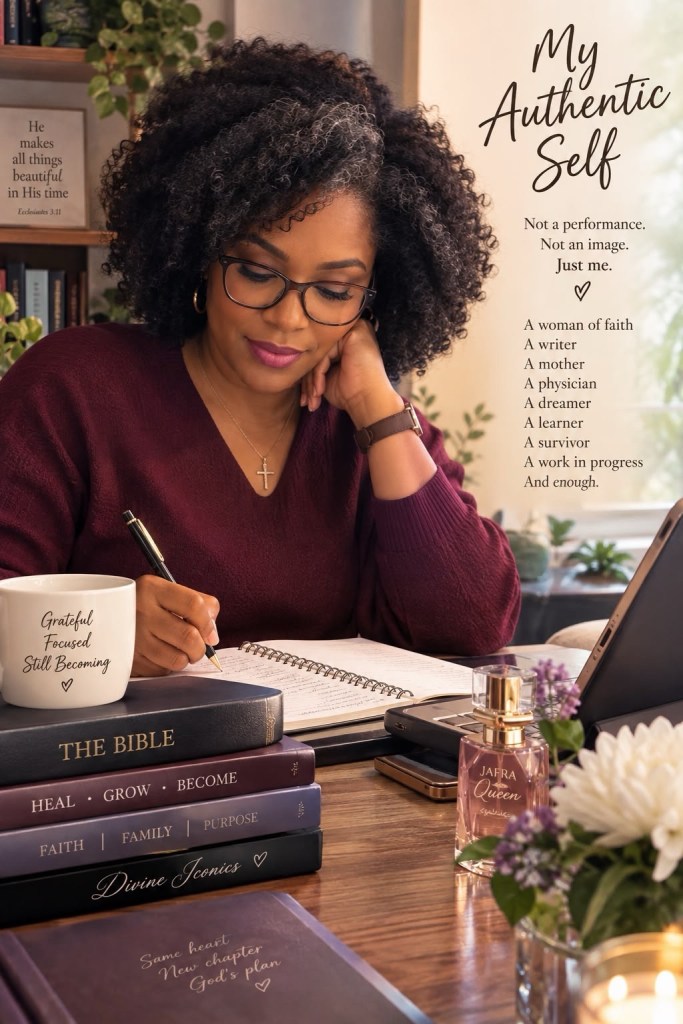
My Authentic Self

I have been thinking a lot about authenticity.

Not the kind we talk about casually, but the kind that makes you stop and ask yourself some uncomfortable questions.

Why do I do what I do?

Do I actually like it?

Do I actually want it?

Or am I doing it because I want to fit in, be accepted, be admired, or simply because everyone else seems to be doing it?

Sometimes we do things without ever stopping to ask ourselves why.

We keep up with the Joneses.

We change the way we dress.

We change the way we talk.

We change the way we present ourselves.

We even change parts of ourselves because we think it will make people like us more.

And somewhere along the way, we can lose track of the person underneath all of that.

That was something I had to think about for myself.

I have always been adventurous and ambitious. I enjoy learning, trying new things, and being around people. I often find myself surrounded by people younger than me, and I enjoy it.

But for several years, I was trying very hard to maintain a younger version of myself.

I dyed my hair.

I plucked out the gray.

I paid attention to how I moved, how I talked, how I dressed, and how I presented myself.

There was nothing wrong with any of those things by themselves.

There is absolutely nothing wrong with dyeing your hair.

If you love changing your hair because you enjoy variety, creativity, fashion, art, or simply because you like trying something different, there is nothing inauthentic about that.

If you are a stylist, an artist, a performer, or someone whose profession involves appearance and creativity, expressing yourself through your hair can be part of your authentic self.

The question is not whether your hair is gray, black, brown, red, or any other color.

The question is:

Are you doing it because it represents you, or because you are afraid of being you?

That was the question I eventually had to ask myself.

Toward the end of last year, especially around November and December, I entered a period of reflection.

I started thinking about more than my hair, my clothes, or the things I owned.

I started thinking about the life I actually wanted.

And one question kept coming to mind:

What if Jesus comes?

What if life is shorter than I think?

What if I spend all this time trying to become an image of what I think I should be, only to realize that I never really enjoyed being myself?

That changed something in me.

I stopped dyeing my hair.

I stopped plucking the gray.

I became more comfortable dressing in ways that reflected who I am and what I believe.

Most importantly, I became more comfortable with myself.

And then I began noticing something.

People seemed to respond to me differently.

I felt more respected.

I felt that people listened more.

I felt more understood.

I felt that people believed me more readily.

And I began attracting people who seemed comfortable with the person I actually was.

Maybe everyone else did not suddenly change.

Maybe I changed what I was projecting.

There is a difference between projecting faith and projecting fake.

There is a difference between growing and performing.

There is a difference between improving yourself and constantly trying to become someone you think other people will approve of.

You can grow without pretending.

You can improve without erasing yourself.

You can change your appearance without changing your identity.

You can enjoy beautiful things without needing them to prove your worth.

You can be ambitious without pretending to be someone else.

You can be youthful in spirit without pretending you are not aging.

You can love fashion without being controlled by it.

You can dye your hair and still be authentic.

You can leave your hair gray and still be authentic.

Authenticity is not about what you look like. It is about whether your life reflects who you really are.

And then I started thinking about confidence too.

Sometimes a person has a strong personality. They are confident. They can discern situations. They make decisions. They know themselves.

People notice that.

People are attracted to confidence. They gather around it. They admire it.

But sometimes admiration can get into a person’s head.

What began as confidence can become pride.

What began as self acceptance can become arrogance.

What began as a strong personality can become a desire to control, dominate, or make other people feel small.

That is when something that started beautifully can become something harmful.

So loving yourself does not mean believing you are better than everyone else.

It means knowing who you are without needing to make someone else feel less than you.

Your authentic self deserves room to breathe.

And perhaps the greatest question is not whether everyone else likes you.

Perhaps the question is:

Do you like you?

Because if you spend your whole life trying to make everybody else like you, you may eventually wake up and realize that you never took the time to know yourself.

If God calls me home one day, I want to know that I lived.

Not a performance.

Not an image.

Not a version of me created to satisfy everyone else’s expectations.

Just me.

My authentic self.

And I think that is enough.

Author’s Notes

Authenticity does not mean refusing to grow. It does not mean refusing to change your appearance. It does not mean refusing advice or believing you are always right.

It means knowing yourself well enough to make choices that are genuinely yours.

And perhaps most importantly, it means learning to love yourself without losing humility.

Scripture for Reflection

“The Lord looks at the heart.”
1 Samuel 16:7

“Am I now trying to win the approval of human beings, or of God?”
Galatians 1:10

By Joan A. Roberts

Life can be more fulfilling in an Authentic self.

Honey, I Missed You

When did we become so stuck in the 60s and 70s?

We are in 2026.

Sometimes I wonder why expressing love to the person we married can become so difficult.

“Hi, good evening. Hey, how are you?”

“Good. How are you?”

“Long time no see you.”

We can be warm, friendly, expressive, and genuinely interested when we meet strangers, acquaintances, coworkers, and people we have not seen in a while.

But sometimes, with the person we married and the people closest to us, something changes.

Why?

Why do we sometimes take the people we love the most for granted?

A husband comes home late.

He usually comes home at six, but tonight it is nine.

Instead of saying,

“Honey, I missed you. What happened?”

we say,

“Where have you been?”

“You forgot the children’s football game.”

“You didn’t call.”

And suddenly, what could have been a conversation becomes an argument.

Maybe something happened.

Maybe there was a delay.

Maybe he had a difficult day.

Maybe he simply lost track of time.

Whatever the reason, wouldn’t it be better to ask before assuming?

“Baby, I missed you. What happened?”

That doesn’t mean we ignore problems.

It doesn’t mean we make excuses for poor behavior.

It doesn’t mean we overlook dishonesty, neglect, or anything that genuinely needs to be addressed.

It simply means that sometimes we can approach the person we love with tenderness before frustration.

Sometimes the person coming home late doesn’t need a lecture the moment they walk through the door.

Sometimes they need to know they were missed.

And sometimes you need to know that you were missed too.

Marriage is not a call to cage someone.

It is not a command to tie another person so tightly to you that they can no longer breathe.

Your spouse was a person before they met you.

They had siblings.

They had friends.

They had interests.

They had dreams.

They had responsibilities.

They had a life.

Marriage brings two lives together, but it does not erase the individual lives that existed before the marriage.

If he wants to spend some time with his siblings or his friends, perhaps that is okay.

And you can spend time with your girlfriends too.

You can have your own interests.

You can laugh with your own friends.

You can have something that belongs to you outside of your marriage.

Love does not have to mean possession.

Sometimes giving each other room to breathe actually gives the marriage more room to grow.

And perhaps many of the things that cause unnecessary tension could be softened if we remembered that.

Marriage is friendship too.

It is understanding.

It is asking questions.

It is learning each other’s weaknesses.

It is making room for each other’s humanity.

It is being able to say,

“You may not be at your best today, honey, but I’m here.”

It is being able to say,

“I may not understand everything you are going through, but I’m willing to listen.”

It is a touch on the hand.

A pat on the back.

Helping with the laundry.

Making a meal.

Sitting beside each other after a long day.

A hug that says more than words.

These things may look small, but they are expressions of love.

Love is not only what happens in the bedroom.

What happens when one of you becomes sick?

What happens when age changes your body?

What happens when one of you is no longer able to perform the way you once did?

Would the friendship still be there?

Would the tenderness still be there?

Would we still remember the vows?

Marriage is hard.

We should not pretend otherwise.

There will be days when one person needs more understanding than the other.

There will be days when one of you is tired, frustrated, distracted, jealous, overwhelmed, or simply not at your best.

That is when friendship matters.

And I am not suggesting that anyone remain in a loveless marriage or in a relationship where one person refuses to communicate, sacrifice, grow, or make the relationship better.

Love requires participation from both people.

But perhaps we could try a little more.

Perhaps we could be a little more expressive.

Perhaps we could stop being so afraid to say what we actually feel.

Instead of saying,

“Where have you been?”

sometimes we could say,

“Honey, I missed you.”

Instead of immediately assuming the worst, perhaps we could ask,

“What happened?”

Instead of waiting for a special occasion to show love, perhaps we could simply show it in the ordinary moments.

Because life is short.

A little accident can change everything.

And sometimes the greatest regret is not what we said.

It is what we never said.

The hug we never gave.

The “I missed you” we swallowed.

The “I’m glad you’re home” we thought but never expressed.

The “I love you” we assumed they already knew.

We assume there will always be another day.

Another evening.

Another conversation.

Another opportunity.

But none of us is promised tomorrow.

So perhaps we should love a little more intentionally.

Not by controlling each other.

Not by making excuses for each other.

Not by ignoring problems.

But by remembering that the person beside us is human.

A person who needs friendship.

A person who needs grace.

A person who needs affection.

A person who needs to know that they are loved beyond what they can provide or accomplish.

“I love you” is beautiful.

But sometimes “I love you” is easy to say.

Living it is different.

Love is in the everyday things.

It is in patience.

It is in sacrifice.

It is in friendship.

It is in understanding.

It is in making room.

It is in showing up.

It is in being able to say,

“I got you, even in your weakness.”

Not because we are making excuses.

Not because we are ignoring problems.

But because we have chosen to love a real person, not a perfect one.

Perhaps we don’t need less love.

Perhaps we need to become a little better at showing it.

And maybe, every now and then, instead of asking,

“Where have you been?”

we can simply say,

“Honey, I missed you.”

Author’s Notes

Sometimes I think about how easily we can be warm, friendly, and expressive with strangers and acquaintances, yet become strangely different with the person we married and the people closest to us.

Why is that?

Why do we sometimes take the people we love the most for granted?

Life is short. We don’t know what tomorrow holds. A little accident can change everything, and suddenly we may find ourselves wishing we had said the words we thought could wait.

So say them.

Show them.

Make the call.

Give the hug.

Sit down together.

Laugh together.

Make room for each other.

Love is not only found in the big moments. Sometimes it is hiding in the smallest things we do every day.
By Joan A.Roberts

Love ❤️ can be a good thing.

Title: Where Softness survives.

There is something I’ve been sitting with quietly.

Not everyone loves children.
And that is okay.

Some people choose a different life
a quieter home,
a different kind of responsibility,
a different rhythm.

That is their right.

But what I don’t understand…
is the need to disturb those who chose differently.

To watch children playing
safely, freely, joyfully
and still find a reason to complain.

To call authorities not out of danger,
but out of discomfort.

And yet, when eyes arrive to see the truth,
there is nothing but children being children.

I chose this life.

I prayed for it.
I longed for it.
I welcomed it.

And I will not silence it.

I will not cage laughter.
I will not dim their voices.
I will not teach them that joy must be hidden to make others comfortable.

Children are meant to move.
To explore.
To grow into their voices, their limbs, their freedom.
within safety, within love.

They are softness in a world that hardens too quickly.

They remind me of something pure,
something unguarded,
something real.

And I choose to protect that.

This is not resistance.
This is not conflict.

This is simply a boundary.

Live your life.
Make your choices.
Find your peace in the way that fulfills you.

But allow others the same grace.

Leave and let live and let softness survive.

“Gratitude for what remains soft in a world that tries to harden you.
Let children be children.
By Joan Roberts

Dad and mums favorite 😍

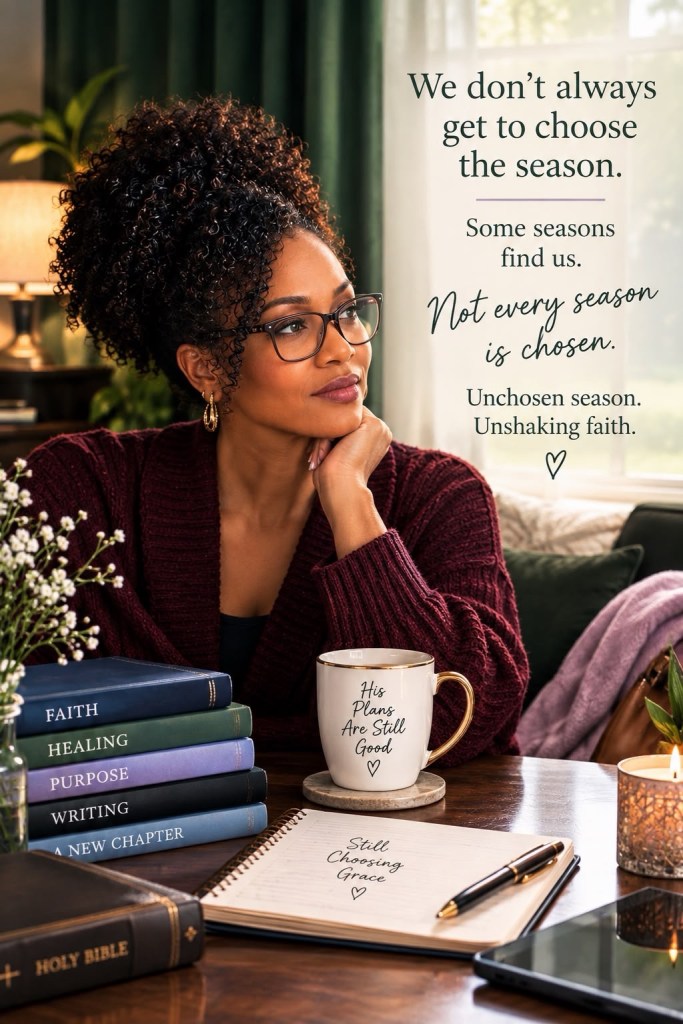
Some seasons find us!

Life can change in just one instant.

There are days I cannot move my limbs. Days I need a cane or scooter. Days when movement is painful and even driving becomes difficult. Days when I have to reach out to friends and colleagues for help.

But through it all, I have not cursed God.

Like Job, I am still searching. I am still asking questions. I am still trying to understand the reason for this season.

And perhaps I am beginning to find it.

I found my voice.

I found a reason to share my pain, my journey, my purpose, and my hope. To remind someone else that even in a difficult season, life is still worth living and purpose is still worth pursuing.

Even if my journey eventually leads to a wheelchair, I am not giving up on God or the purpose He has placed in me.

I am still going to pursue my dreams. To become the doctor I am called to be. To write. To build. To be a mother and wife. To become everything God has placed within me.

And you should not give up either.

Stay with me on this journey. Read my stories. Maybe something in my story will help you make sense of yours.

There is still life. There is still hope. There is still purpose.

InASeasonOfPainThereIsPurpose #DoNotGiveUp #FaithAndHope #Purpose #HealingJourney #GodIsStillWithMe

I am content and I know my place in God but I have intentionally choosen to use this season to be a blessing to another through my writings. My voice can reach a million people even though my limbs may scarcely be medically fit to move around most days.
I am still grateful to God for life and so should you.
By Joan Roberts.

In a Season of Pain, There Is Purpose

Today in church, I was reminded to conduct my life in a way that pleases God. And the Gospel reminded me: “The last will be first, and the first will be last.” — Matthew 20:16

VanityMakesNoSense

One accident can change your life forever.

One unexpected event.
One moment of distraction.
One slip on water in your own home.
One incident that happens while you are simply sitting on your couch.

Life can change in an instant.

So what do we do when we find ourselves in a season we never planned for?

Do not despair.

If you are on a journey of healing and recovery, remember that God has been there through the accident, through the pain, through the uncertainty, and through every difficult day. And He will see you through.

Perhaps there is a lesson to learn.

Perhaps there is a talent waiting to be discovered.

Perhaps there is a faith that needs to be reignited.

Perhaps there is a business waiting to be created.

Perhaps there is a purpose you could not see before because life was moving too quickly.

We may not understand the season we are in, but we can still ask God what He wants to do with it.

In a season of pain, there is purpose.

Do not despise the season.
Do not give up on yourself.
Do not assume that because your life changed, your purpose ended.

Sometimes, what feels like an interruption becomes the beginning of something we never imagined.

Conduct your life in a way that pleases God. Trust Him with the journey. And keep going.

VanityMakesNoSense

InASeasonOfPainThereIsPurpose

HealingAndRecovery

FaithOverFear

TrustGod

PurposeDrivenLife

GodIsWithYou

By Joan Roberts

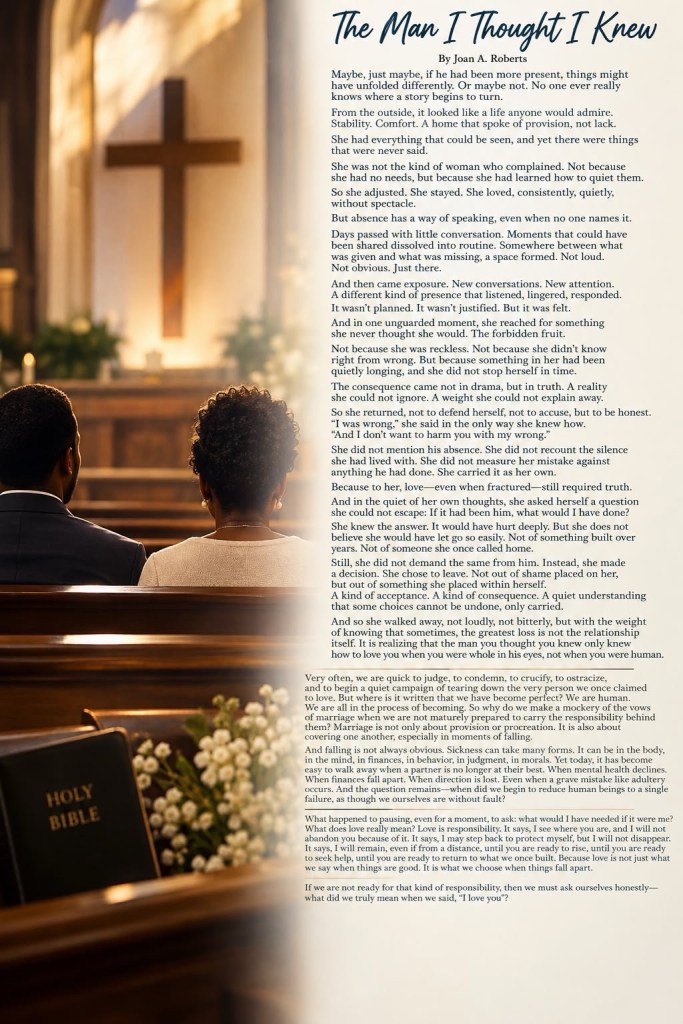
The Man I Thought I Knew.

Maybe, just maybe, if he had been more present, things might have unfolded differently.

Or maybe not.

No one ever really knows where a story begins to turn.

From the outside, it looked like a life anyone would admire. Stability. Comfort. A home that spoke of provision, not lack.

She had everything that could be seen, and yet there were things that were never said.

She was not the kind of woman who complained. Not because she had no needs, but because she had learned how to quiet them.

So she adjusted. She stayed. She loved, consistently and quietly, without spectacle.

But absence has a way of speaking, even when no one names it.

Days passed with little conversation. Moments that could have been shared dissolved into routine. Somewhere between what was given and what was missing, a space formed.

Not loud. Not obvious. Just there.

And then came exposure.

New conversations. New attention. A different kind of presence, one that listened, lingered, responded.

It was not planned. It was not justified.

But it was felt.

And in one unguarded moment, she reached for something she never thought she would.

The forbidden fruit.

Not because she was reckless. Not because she did not know right from wrong.

But because something in her had been quietly longing, and she did not stop herself in time.¹

The consequence came not in drama, but in truth.

A reality she could not ignore. A weight she could not explain away.

So she returned, not to defend herself, not to accuse, but to be honest.

“I was wrong,” she said in the only way she knew how. “And I do not want to harm you with my wrong.”

She did not mention his absence. She did not recount the silence she had lived with. She did not measure her mistake against anything he had done.

She carried it as her own.

Because to her, love, even when fractured, still required truth.

And in the quiet of her own thoughts, she asked herself a question she could not escape.

If it had been him, what would I have done?

She knew the answer.

It would have hurt deeply.

But she does not believe she would have let go so easily. Not of something built over years. Not of someone she once called home.

Still, she did not demand the same from him.

Instead, she made a decision.

She chose to leave.

Not out of shame placed on her, but out of something she placed within herself.

A kind of acceptance. A kind of consequence.

A quiet understanding that some choices cannot be undone, only carried.

And so she walked away, not loudly, not bitterly, but with the weight of knowing that sometimes, the greatest loss is not the relationship itself.

It is realizing that the man you thought you knew only knew how to love you when you were whole in his eyes, not when you were human.²

Very often, we are quick to judge, to condemn, to crucify, to ostracize, and to begin a quiet campaign of tearing down the very person we once claimed to love.³

But where is it written that we have become perfect?

We are human. We are all in the process of becoming.

So why do we make a mockery of the vows of marriage when we are not maturely prepared to carry the responsibility behind them?

Marriage is not only about provision or procreation. It is also about covering one another, especially in moments of falling.

And falling is not always obvious.

Sickness can take many forms. It can be in the body. It can be in the mind. It can be in finances, in behavior, in judgment, in morals.

Yet today, it has become easy to walk away when a partner is no longer at their best. When mental health declines. When finances fall apart. When direction is lost. Even when a grave mistake like adultery occurs.

And the question remains, when did we begin to reduce a human being to a single failure, as though we ourselves are without fault?

What happened to pausing, even for a moment, to ask what would I have needed if it were me?

What does love really mean?

Love is not blind acceptance of harm, and it is not the absence of boundaries. Love is responsibility.

It says, I see where you are, and I will not abandon you because of it.

It says, I may step back to protect myself, but I will not disappear.

It says, I will remain, even if from a distance, until you are ready to rise, until you are ready to seek help, until you are ready to return to what we once built.

Because love is not just what we say when things are good.

It is what we choose when things fall apart.

So we must ask ourselves honestly.

What did we mean when we said, “I love you”?

What did we mean when we stood before a congregation and before God and said, “for better, for worse”?

Was it commitment, or was it convenience?

Was it covenant, or was it performance?

Or have we reduced something sacred to a moment of appearance, dressed in fine clothes, spending money, and calling it love while emptying it of its true meaning?

At what point did we become comfortable making a mockery of God, of marriage, and of the very vows we once spoke with our own mouths?

¹ “When the woman saw that the fruit of the tree was good for food and pleasing to the eye… she took some and ate it.” — Genesis 3:6

² “Let any one of you who is without sin be the first to throw a stone.” — John 8:7

³ A reflection on our human tendency to judge others harshly while overlooking our own imperfections.

By Joan.A Roberts